Key benchmarks at a glance
Takeaway: In the DC-metro commercial market, the median ABA reimbursement rate is $15.00 per 15-minute unit for 97153 (direct therapy), $21.00 for 97151 (assessment), and $19.00 for 97155 (protocol modification). These figures reflect commercial payer data for Aetna, Cigna, and Optum/UHC - not DC Medicaid rates.
What ABA practices in DC actually get paid
If you run an ABA practice in the Washington, DC metro area (which, for this analysis, includes nearby Maryland and Virginia providers serving the DC market), you already know the hardest number to pin down is also the most important one: what payers will actually reimburse.
ABA reimbursement rates are rarely published, vary widely between insurers, and are almost never shared between practices, which leaves most owners negotiating contracts with no idea whether the number on the table is fair.
The lack of transparency is especially pronounced in commercial insurance, where reimbursement rates are typically negotiated privately.
This guide fixes that. We analyzed commercial fee-schedule data for 60 DC-metro ABA provider organizations across the market's negotiated payers to build a clear picture of ABA billing rates for the three codes that drive your revenue: 97151, 97153, and 97155.
Below you'll find the median, percentile ranges, and payer-by-payer breakdown, plus how to use these benchmarks the next time you sit down with a managed-care organization.
Flychain builds tools that help ABA practices see their financials and make data-driven decisions rather than guesswork, including contracted rate analysis that benchmarks your own contracts against the market.
We put this analysis together from the same underlying rate data our team works with every day, and it complements our broader 2026 ABA Practice Financial Benchmark Report.
Want to see if you’re leaving money on the table?
Get a free financial assessment from our healthcare accounting experts.
What this DC ABA reimbursement rate data covers
Before diving into the numbers, a quick note on the data source. These figures come from negotiated commercial reimbursement rates reported through the federal Transparency-in-Coverage machine-readable files for Aetna, Cigna, and Optum/UnitedHealthcare between May 2025 and May 2026.
- Geography: DC-metro ABA providers (DC, plus nearby MD and VA billers serving the DC market).
- Unit: Every rate is per 15-minute unit, the standard billing increment for these codes.
- Codes: 97151 (assessment), 97153 (direct 1:1 therapy - the highest-volume code), and 97155 (protocol modification by a QHP).
A note on CareFirst BlueCross BlueShield: Within this dataset, CareFirst publishes a single uniform fee schedule, which is applied identically across every provider in this market, rather than individually negotiated rates. As a result, it offers little opportunity for benchmarking negotiated commercial contracts, so we have excluded it from the payer comparison below. This report focuses on the three payers where rates are actually negotiated: Aetna, Cigna, and Optum/UHC.
Important: these are commercial rates, not DC Medicaid MCO rates (HSCSN, MedStar Family Choice, AmeriHealth Caritas DC), which are not published in Transparency-in-Coverage files and typically price below commercial. Use these commercial figures as a market benchmark and negotiation anchor; not as a prediction of Medicaid reimbursement.
For a broader explanation of what each code covers, how credential modifiers affect reimbursement and how these rates compare across markets, see our 2026 ABA CPT Code & Reimbursement Guide. You can also download the one-page cheat sheet for a quick desk reference.

ABA reimbursement rates by CPT code in DC (the market benchmarks)
Here are the pooled ABA therapy reimbursement rates across the three negotiated commercial payers, per 15-minute unit. The median is your single best opening anchor; the 75th and 90th percentiles show what stronger contracts look like in this market.
What is the reimbursement rate for 97153 (direct therapy) in DC?
Since direct 1:1 therapy is typically the highest-volume CPT code for center-based ABA providers, the 97153 reimbursement rate is the single most economically important number in any contract.
In this DC dataset, the median negotiated commercial rate is $15.00 per 15-minute unit (roughly $60 per hour), with the middle 50% of contracts falling between $13.76 and $17.57 per unit.
Increasing reimbursement by even $1-2 more per unit on 97153 moves your whole P&L, because it applies to the highest-volume code.
What is the reimbursement rate for 97151 (assessment) in DC?
Assessment (97151) shows the widest spread of any code: from a low of $14.49 to a high of $38.60 per unit, a difference of more than 2.5x for the same service.
The median sits at $21.00. Although assessment volume is lower than direct therapy, the wide reimbursement variation means many practices overlook meaningful revenue opportunities during contract reviews.
What is the reimbursement rate for 97155 (protocol modification) in DC?
Protocol modification (97155), typically delivered by a BCBA, has a median of $19.00 per unit and a 90th percentile of $28.86.
Since it's a higher-rate but lower-volume code, it's easy for a payer to concede on 97153 while quietly underpricing 97155, so check every code in a contract, not just the headline direct-therapy rate.
ABA reimbursement rates by payer in DC
The pooled median hides a lot. When you break ABA reimbursement rates by payer, the differences are real: the same code can pay noticeably more depending on which insurer's contract you're looking at, and even within a single payer, rates vary from one provider to the next.
The takeaway: When negotiating rates, the most meaningful comparison is not across payers; it’s within each payer. Insurers are rarely persuaded by what another payer pays for the same CPT code. Instead, the strongest negotiating position comes from demonstrating that another provider is receiving higher reimbursement from the same payer for the same CPT code.
Knowing where your rates sit relative to the market distribution for each payer helps you identify which contracts have the greatest upside and prioritize the negotiations most likely to deliver meaningful results.
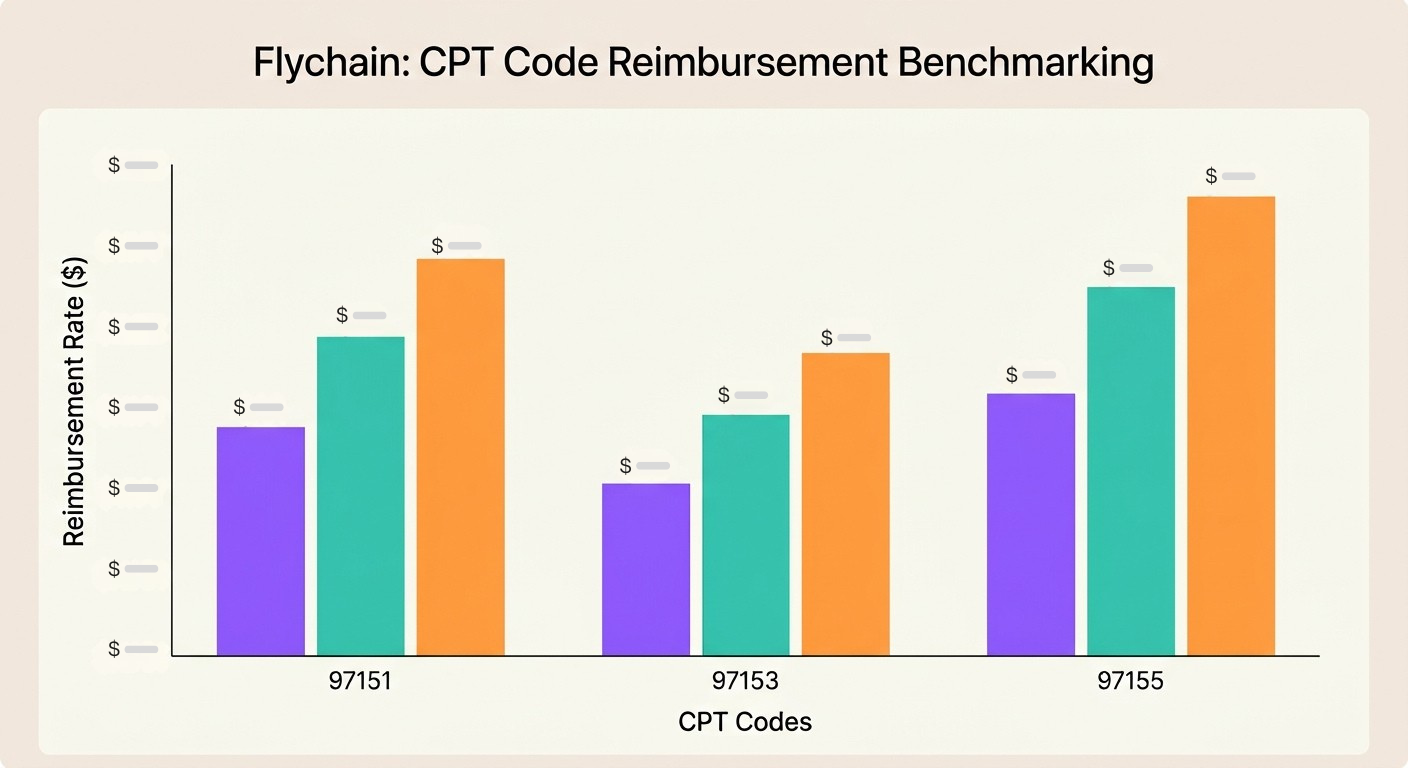
Want a quick sense-check on where your rates sit? Use our free self-serve tool to compare your rates against the DC market in minutes.
▶ Try the free ABA contracted rate tool
How credential level affects ABA billing rates (Optum data)
Optum/UHC is the only payer in this dataset that reports credential modifiers, so the figures in this section are Optum-specific; Aetna and Cigna publish unmodified rates.
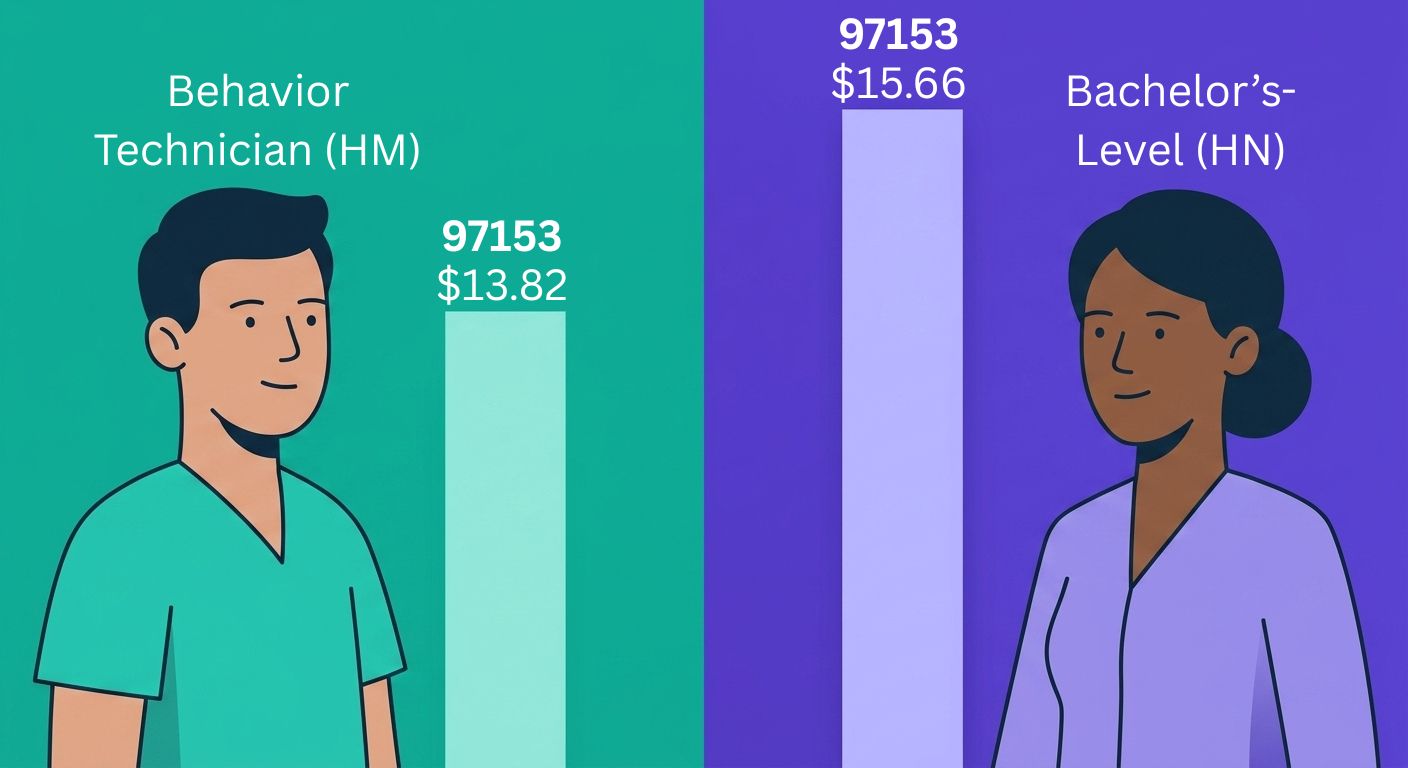
Where Optum prices by credential, the modifier matters: direct therapy (97153) delivered under the HM modifier (RBT / technician level) prices lower than the same code under the HN modifier (bachelor-level provider; commonly BCaBA or other bachelor’s-level clinician depending on payer policy).
Bachelor-level direct therapy prices roughly 12–15% above RBT-level in this dataset. Since RBTs deliver most 97153 hours, the HM tier is the higher-volume billing level — so if you staff a mix, confirm how each payer treats these modifiers before you sign.
How to use these ABA reimbursement rates in DC payer negotiations
Benchmarks are only useful if they change what you do at the negotiating table. Here's how ABA practice owners can turn this data into leverage:
1. Anchor to the 90th percentile for that specific payer
Open your ask at the 90th-percentile rate for the payer you're negotiating with - not the pooled market median. Opening high, but at a number real contracts in that payer's own network actually reach, gives you room to negotiate while staying credible. The per-payer tables below give you that anchor for each code.
Anchor targets (90th percentile, per 15-minute unit):
- Aetna: 97151 $29.00 / 97153 $21.26 / 97155 $28.86
- Cigna: 97151 $31.00 / 97153 $19.41 / 97155 $31.00
- Optum (UHC): 97151 $35.67 (HN) / 97153 $17.57 (HM) or $19.91 (HN) / 97155 $23.06 (HN).
2. Lead with intra-payer disparity
One of the strongest negotiation arguments you have is that another provider gets paid more by the same payer for the same code.
Payers rarely react to what a competing insurer pays, but they do respond to internal inconsistency in their own network. Frame your ask around that.
If your practice serves an underserved geography, has limited provider availability, or supports access-to-care goals, network adequacy can become an additional source of negotiating leverage alongside reimbursement benchmarks.
3. Know your own numbers first
You can't tell whether an offer is good until you know your cost to deliver an hour of care and your current blended rate. This is where practices most often get caught flat-footed and where a clear financial picture pays for itself.
If you don't have that number today, Flychain's Full-Service CFO for ABA practices builds that diagnosis before your next payer conversation.
Want these benchmarks in a one-page reference? Download the free DC ABA rate cheat-sheet - every code and payer, plus a negotiation checklist, on a single page.
How to interpret your own ABA reimbursement rate
Once you know your current rate for a code, these DC-metro benchmarks tell you what to do next. A quick way to read your position:
If your rate is below the median: review the contract at your next renewal — you're behind the middle of the market for that code.
If your rate is below the 25th percentile: prioritize renegotiation. You're in the bottom quarter of DC-metro rates, and this is where the clearest upside is.
If your rate is near the 90th percentile: you're already well-positioned on rate, so shift your attention to volume, authorization quality, and collections efficiency - that's where additional margin will come from.
Why ABA reimbursement rates make or break DC practice profitability
Reimbursement rates are only half the profitability equation. The other half is what it costs you to deliver care.
Direct therapy is labor-intensive, and labor costs - including RBT wages, BCBA salaries, and employee benefits - have continued to increase. This means the gap between your 97153 rate and your fully loaded cost per hour is thin for most practices. A few dollars per unit can be the difference between a healthy margin and running at break-even.
That's why the practices that thrive treat rate data as a living input, not a one-time exercise. They know their rate by payer, they have an established relationship with their payer representative, they know their cost to serve, and they revisit contracts on a yearly basis.
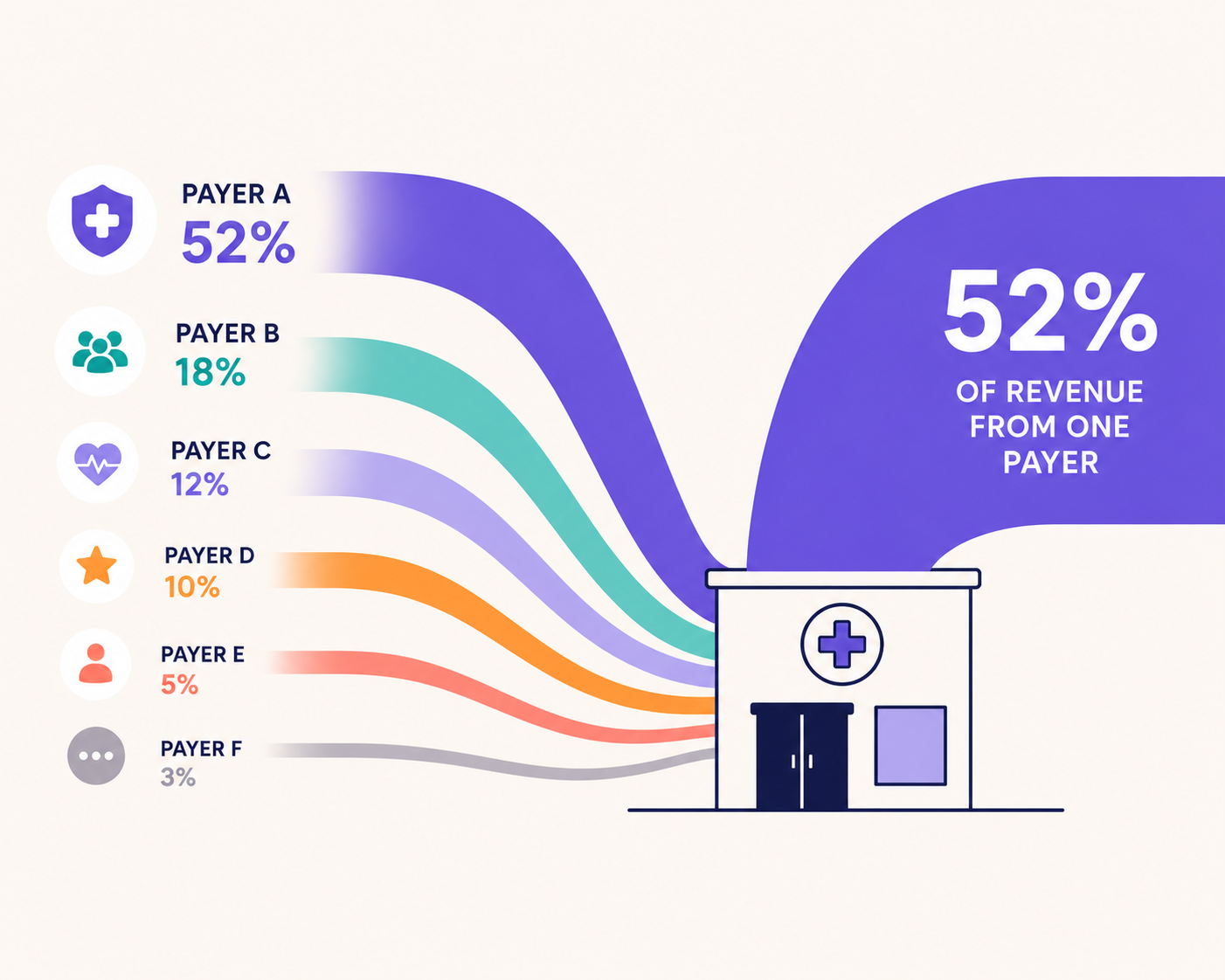
On top of Flychain's accounting and bookkeeping platform, which surfaces your key financial KPIs, including revenue broken down by payer, so you can understand your economics payer by payer; the Flychain CFO Hub adds the benchmarking tools that make rate work actionable:
- Flychain’s contracted rate analysis compares your rates for each CPT code against other providers in your state to pinpoint where you're underpaid
- Its expense benchmarking shows how your cost lines stack up against similar practices;
- Its salary benchmarking compares pay by role and state, so - since staffing is the largest cost line in ABA - you can keep compensation competitive without eroding the margin your reimbursement rates are meant to protect.
ABA reimbursement rate FAQs
How much does insurance reimburse for ABA therapy in DC?
Across negotiated commercial payers in the DC metro, the median reimbursement is about $21.00 per 15-minute unit for assessment (97151), $15.00 for direct 1:1 therapy (97153), and $19.00 for protocol modification (97155). Actual rates range widely by payer and contract.
Do ABA reimbursement rates change based on who delivers the therapy?
Yes, they can. Some payers price by credential modifier, and Optum/UHC is the clearest example in this DC dataset. In this example, direct therapy (97153) billed under the HN modifier (bachelor-level, e.g. a BCaBA) pays roughly 12–15% more than the same code billed under HM (RBT/technician level). That's about $15.66 versus $13.82 per 15-minute unit. RBTs deliver most direct-therapy hours, so the lower HM tier is also the higher-volume one. Before signing a contract with a new payer, it’s critical to understand how they reimburse each modifier.
Which payer pays the most for ABA in DC?
It depends on the code, which is why it's worth comparing payer by payer. For direct therapy (97153), which is the highest-volume code, Optum/UHC (bachelor-level HN) and Aetna sit at the top of this DC-metro dataset, both around $15–15.66 per 15-minute unit, while Cigna sits lowest at roughly $10.
Please note that rankings shift on other codes. These are DC figures and shouldn't be read as national rates.
Why do ABA reimbursement rates vary so much between practices?
Most commercial ABA rates are individually negotiated rather than set by a fixed schedule. Across DC-metro negotiated payers, credential modifiers (HM vs HN), contract vintage, and each practice's negotiating leverage all drive the roughly 2.5x spread seen for the same CPT code. Rates also differ by region, so DC figures won't match other markets.
What is the 97153 reimbursement rate in DC?
The median negotiated commercial reimbursement rate for CPT 97153 across the DC metro is $15.00 per 15-minute unit (~$60 per hour). Since 97153 (direct 1:1 therapy) is typically the highest-volume ABA billing code, it has the greatest impact on practice revenue. As a result, it is the most important code to benchmark and prioritize during payer contract negotiations.
How do DC ABA billing rates compare to other states?
ABA reimbursement rates vary widely from state to state. Commercial rates are negotiated privately and differ by regional market, so what a payer pays in one metro in most cases will not match another.
These benchmarks reflect the Washington, DC commercial market specifically. As such, they should not be applied to other states.
If you operate across state lines, benchmark each market on its own rather than assuming one region's ABA therapy reimbursement rates carry over.
Where does this ABA reimbursement rate data come from?
These ABA therapy reimbursement rates are drawn from commercial fee-schedule filings published under federal Transparency-in-Coverage rules.
Specifically, this data set focuses on Aetna, Cigna, and Optum/UHC, covering DC-metro ABA providers between May 2025 and May 2026.
All figures are aggregated and de-identified. They reflect market-wide medians and percentiles, not any individual practice's contract.
Turning ABA reimbursement rates into a stronger contract
Reimbursement will always be the number that decides whether your DC practice grows or just survives.
For too long, ABA owners have negotiated it blind. With these ABA reimbursement rates in hand, you can walk into your next payer conversation knowing exactly where the median sits, what a strong contract looks like, and which of your codes deserve the most attention.
The next step is to compare these benchmarks against your own contracts.
Which payers are underpaying you on 97153? How do your contracted rates fall against the market median and 90th percentiles?
Those answers are specific to your practice, and they are exactly what Flychain’s contracted rate analysis surfaces.
See how your contracted rates compare to the market and where you're leaving money on the table.
— The Flychain Team