.png)
A Hands-On CFO Built for ABA Practices
If you run an ABA practice, you already know it's not like running any other healthcare business.
Your revenue is tied to authorization hours that don't always get used. Your largest cost is a workforce that turns over fast and bills by the quarter-hour. Your margin lives or dies on a cancellation rate most owners can't even measure in real time.
Fractional CFO services most owners can find aren't built for any of that - they're built for businesses in general, and they treat ABA like a footnote.
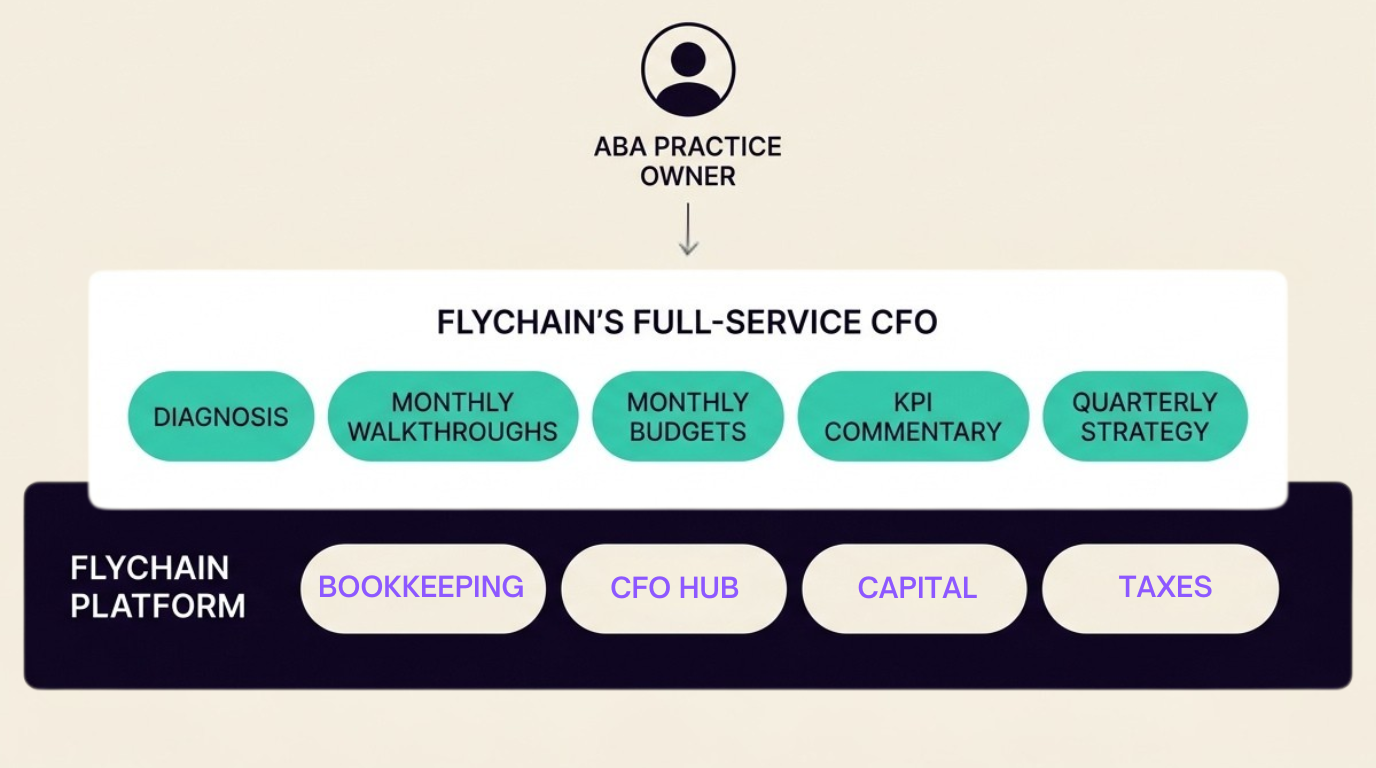
That gap is why we built Flychain's ABA CFO Services: a full-service CFO built specifically for ABA practice owners, delivered as an add-on to the Flychain platform. Our promise is simple: we create the blueprint for your practice to financially thrive, and we work with you to execute it.
This offering is powered by Blueprint Behavioral Advisors, a team of CFOs who've spent their careers inside ABA practices. This is a full-service offering: a real human ABA CFO walks you through your numbers - not a self-serve dashboard pretending to be a CFO.
We built this after conversations with hundreds of ABA practice owners. We listened for what they actually needed from a financial partner, where existing options were failing them, and what would make the difference between surviving and scaling.
Almost every owner described the same gaps. So we built ABA CFO Services to close them.
This article walks through what's inside, what your first 90 days look like, and the kinds of findings we've already surfaced for ABA practices we work with today.
Want to see if you’re leaving money on the table?
Get a free financial assessment from our healthcare accounting experts.
Why ABA Practices Need a Full-Service CFO Built Specifically for ABA
We didn't set out to build ABA-specific CFO services. We built them because, in conversations with hundreds of ABA practice owners, we kept hearing the same problems described the same way.
ABA practices have a financial profile that's structurally different from other healthcare businesses:
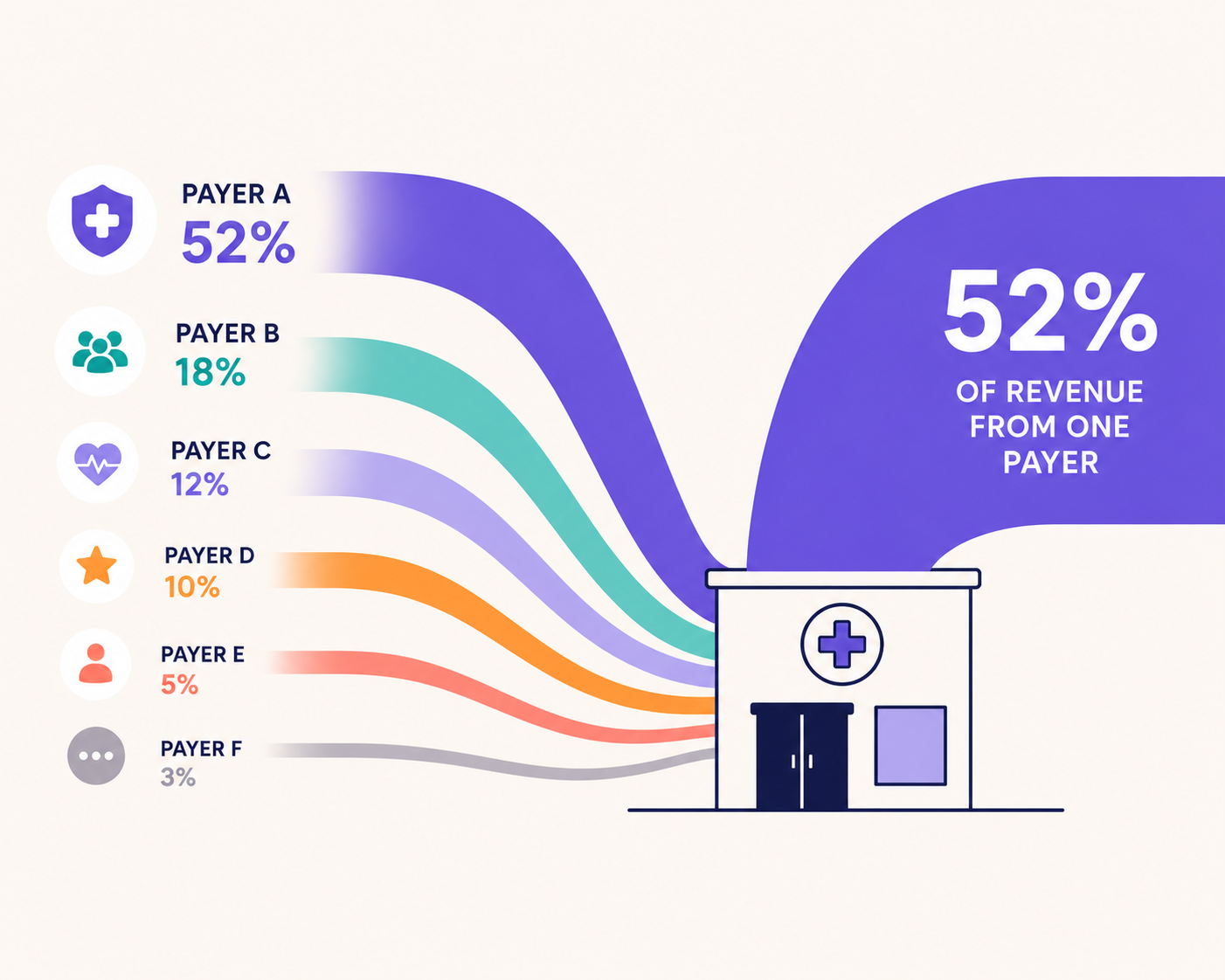
- Payer concentration risk is real and quantifiable. When a single payer represents 40%+ of your revenue, one contract renegotiation can wipe out a year of margin gains. ABA payer mix needs to be tracked as a KPI, not an annual review.
- Authorization utilization is your hidden P&L. If your team delivers 60% of the hours you're authorized to deliver, you've left 40% of your potential revenue on the table. Most owners have no visibility into the gap until it's too late.
- Cancellation rate is the largest revenue leak in the practice. A practice running a 30% cancellation rate against a 15% benchmark is bleeding six figures a year. But cancellations don't show up on a standard P&L. They show up as the absence of revenue, which is a much harder signal to act on.
- Direct labor benchmarks vary by setting. In-home delivery, clinic-based delivery, and hybrid models have structurally different cost profiles. A 72% direct labor ratio that's alarming in a clinic-based model might be normal for an in-home practice. Without setting-aware benchmarks, the numbers don't mean anything.
- Cash flow is brutally seasonal. Collections swing wildly month-to-month. We've seen practices oscillate between 26% and 193% of billings. A CFO who treats those swings as random instead of structural will give you reactive advice every single time.
A fractional CFO who hasn't sat inside dozens of ABA P&Ls will miss every one of these dynamics.
That's why Flychain's ABA CFO Services are powered by Blueprint Behavioral Advisors: an ABA-specialist CFO team that's spent years building the exact pattern recognition this work demands.
Flychain's platform handles the financial and data infrastructure underneath; Blueprint runs the engagement.
What's Inside Flychain's ABA CFO Services
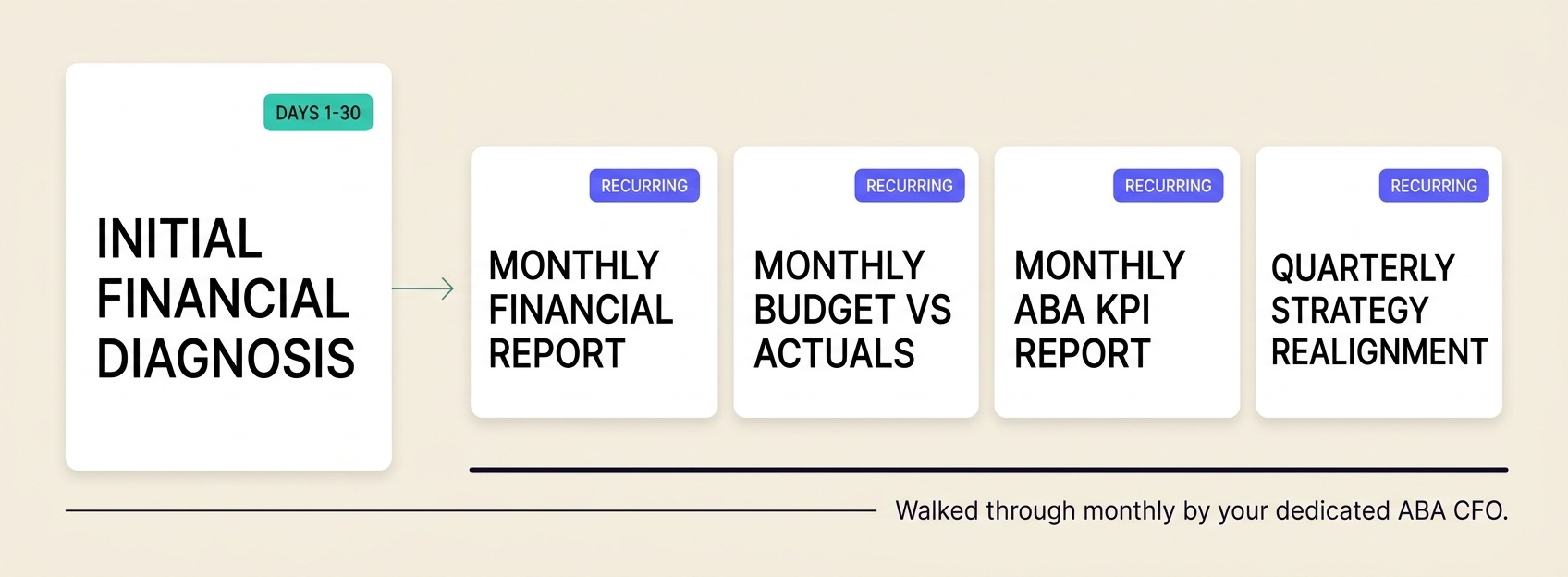
ABA CFO Services are built around five deliverables: one upfront, four recurring. Together they give you a full picture of where your practice stands and where it's going.
Every deliverable is prepared and walked through by your dedicated ABA CFO. You're never handed a report and left to interpret it yourself.
You'll meet with your CFO at least once a month, plus quarterly for strategy. We don't believe in financial reports landing in your inbox without a conversation behind them.
1. Initial Financial Diagnosis
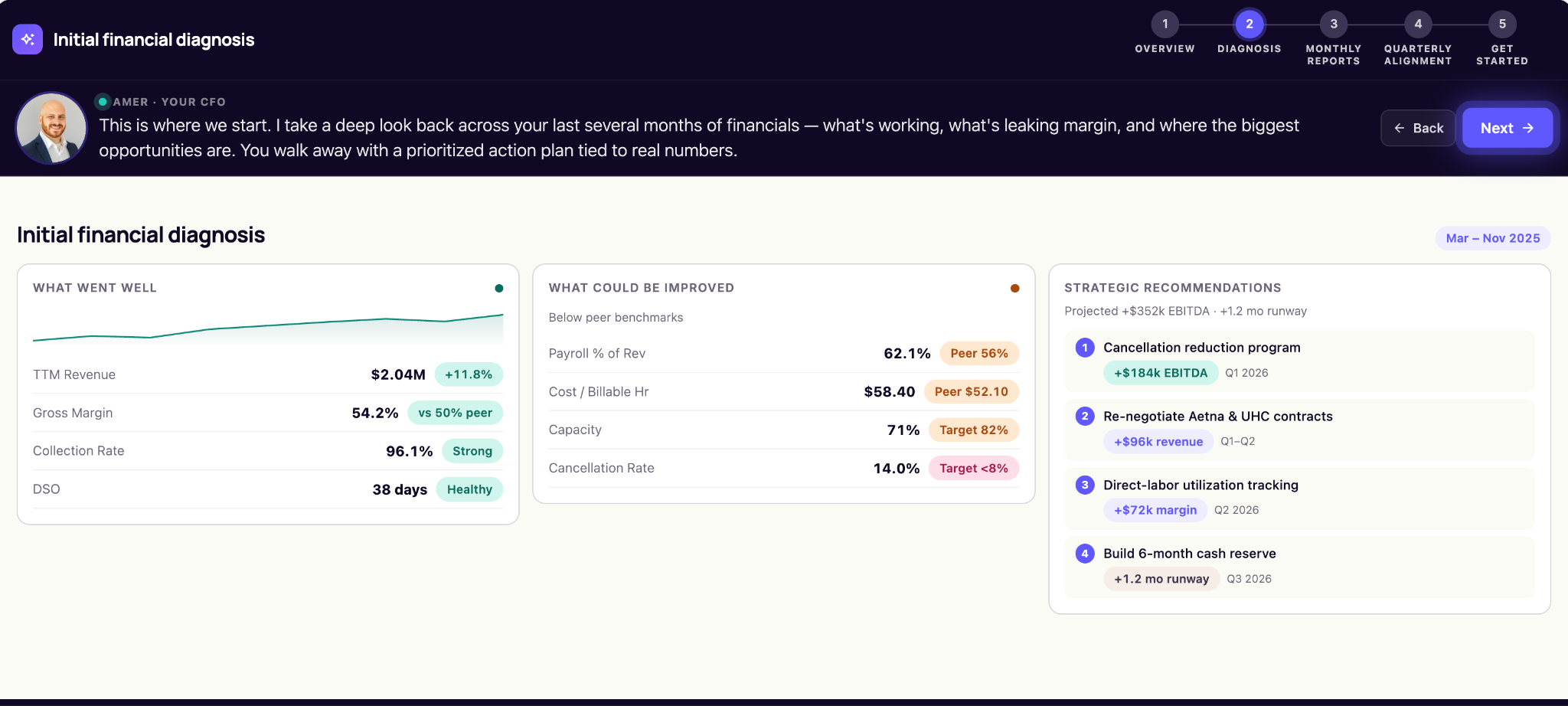
A comprehensive 9-month look-back that establishes your practice's baseline: what's working, what's leaking margin, and where the highest-leverage opportunities sit.
This is the foundation everything else builds on, and it answers the questions every owner is quietly asking but rarely gets straight answers to.
What you get:
- An executive summary with your overall health assessment, top strengths, and the 3–5 highest-leverage priorities for the next 12–18 months.
- A current state assessment across three lenses: financial performance, cash position and liquidity, and operational efficiency.
- Fully developed strategic recommendations with rationale, phased roadmap, and projected financial impact.
- A 12-month base-case revenue and EBITDA forecast with key assumptions and risk factors.
You walk away with a board-ready document you can hand to a lender, a partner, or simply use as your own 18-month action plan.
2. Monthly Financial Report
Most owners get a QuickBooks export from a bookkeeper once a month and have to figure out what it means themselves. The Monthly Financial Report flips that: the numbers come pre-interpreted, the trends are visualized, and the metrics that matter most for ABA sit right next to the standard financial statements.
What you get:
- A written executive summary covering revenue, gross margin, net income, and balance sheet highlights, with explanations of what's driving each number.
- A KPI dashboard tracking current ratio, gross profit margin, billable hours, and cancellation rate against target with a clear status (exceeds / on track / requires attention).
- Full accrual-basis financial statements (balance sheet, income statement, statement of cash flows) with rolling 4-month comparisons.
- Supporting schedules for direct labor, administrative payroll, and operating expenses.
You walk away knowing not just what happened, but why, and what to do about it.
3. Monthly Budgets vs Actuals

A budget without monthly tracking is just a wish list. This deliverable turns the budget into a steering wheel: every month you see exactly where reality diverged from the plan, you understand why, and you decide whether to flex operations or revise the plan.
What you get:
- A monthly budget your ABA CFO builds with you, benchmarked against real ABA-practice data.
- A monthly side-by-side variance summary on every major income statement line (revenue, gross profit, operating expenses, net profit) with status flags (on track / over / miss).
- Written commentary on every material variance, distinguishing one-time items (payroll accrual transitions, FICA resets) from seasonal effects and genuine operational issues.
- Monthly course-correction recommendations where assumptions or operations need to flex.
Without this, owners tend to discover problems six months too late - when they show up in the bank balance instead of the budget report.
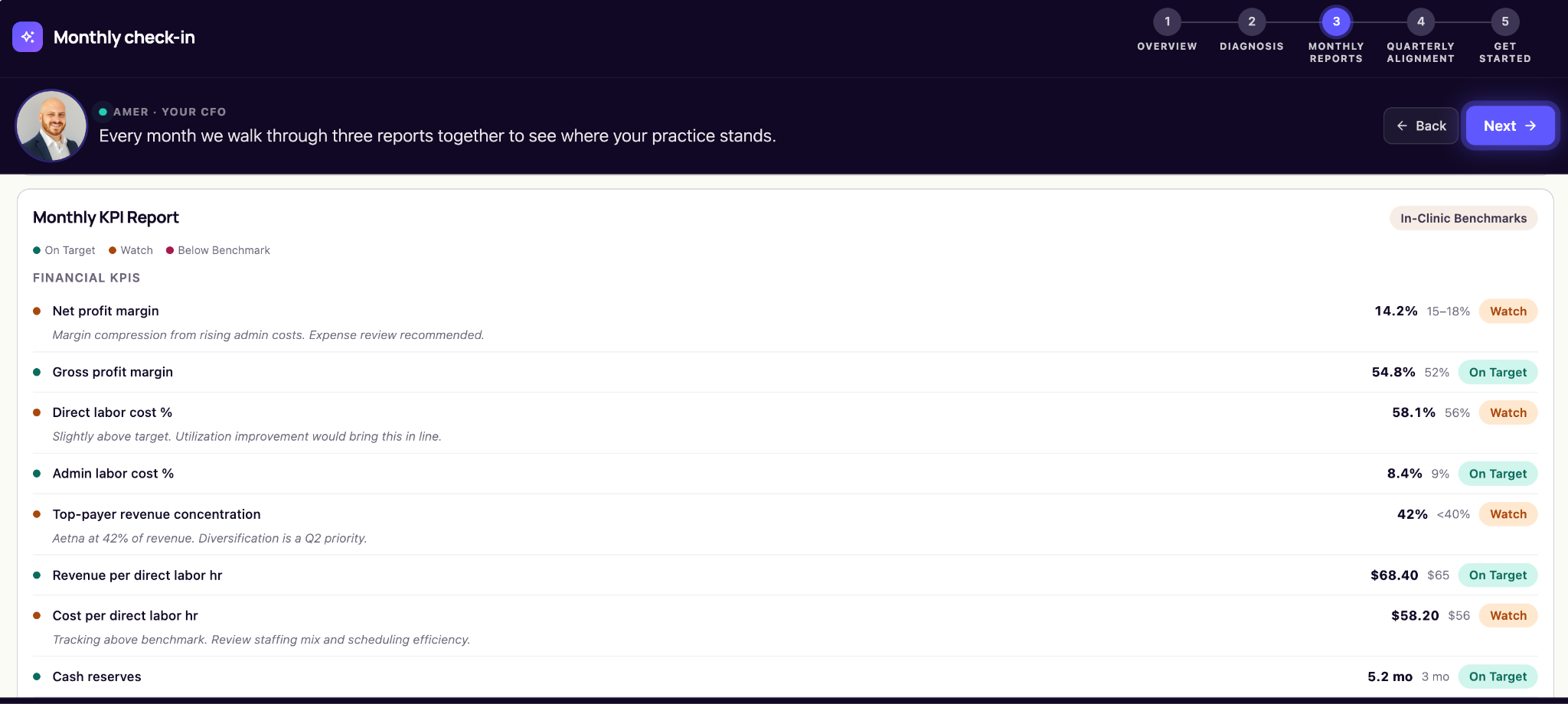
4. Monthly KPI Report

The Monthly ABA KPI Report bridges financial, clinical, and operational data tracking the key metrics that drive financial outcomes.
Most practices operate on revenue and cash balance alone - but by the time those numbers move, the underlying problem has been compounding for months. The KPI Report reverses that: cancellation rates, denial rates, and aged A/R move first, and they tell you exactly what's about to hit the bank account.
What you get:
- Setting-aware benchmarking (in-home vs. in-clinic delivery have structurally different cost profiles).
- Financial KPIs including net and gross profit margin, direct labor cost %, admin labor cost %, payer concentration, revenue per direct labor hour, cost per labor hour, and cash reserves in months.
- Revenue cycle KPIs including days in A/R, % A/R aged > 120 days, net collection rate, first-pass clean claims rate, and denial rate.
- Operational KPIs including authorization utilization, schedule efficiency, family demand fill rate, and cancellation rate.
- Every KPI tagged on target / watch / below benchmark with written analysis.
5. Quarterly Strategy Realignment
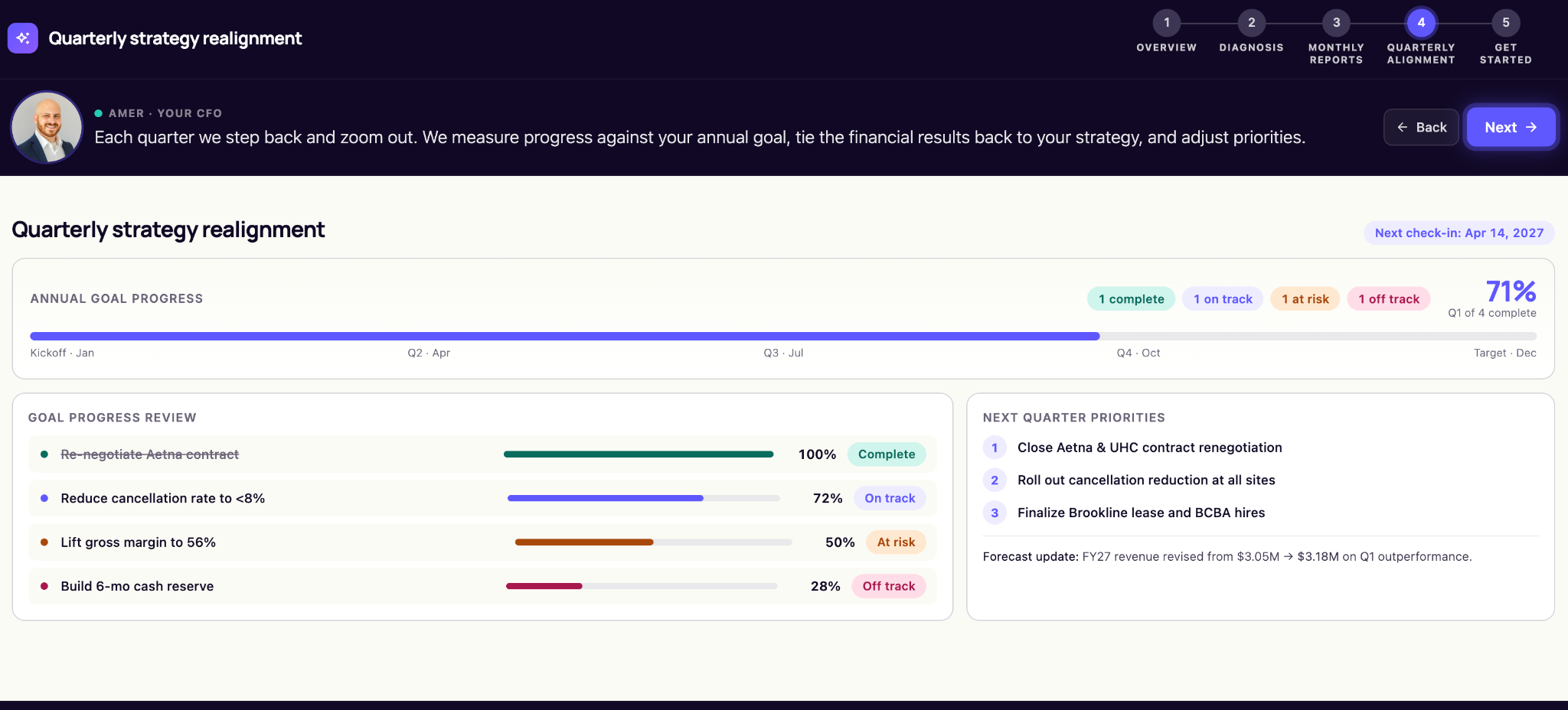
Annual plans drift the moment the year starts. Without a forcing function to revisit them, owners either ignore the plan entirely or pretend it's still on track when it isn't. The quarterly check-in solves both: a structured 90-minute working session four times a year that produces a written record of every decision.
What you get:
- A goal progress review tagging every strategic goal on track / at risk / off track with quantified updates and an honest accounting of obstacles.
- A financial performance discussion connecting the quarter's results back to the strategic plan, including what's driving revenue (census growth, rate changes, payer mix), expense and profitability trajectory, and an updated full-year forecast.
- Documented adjustments and decisions - goal changes (modified, delayed, accelerated, or dropped) with rationale, budget revisions, and other strategic decisions (hiring, payer contracts, capital investments, operational shifts).
- Your top 3 priorities for the next 90 days. Every commitment captured with a named owner and a due date; plus the date locked for the next quarterly check-in.
By Q4, you've had three explicit chances to course-correct rather than discovering at year-end that the plan never had a chance.
What Your First 90 Days Look Like
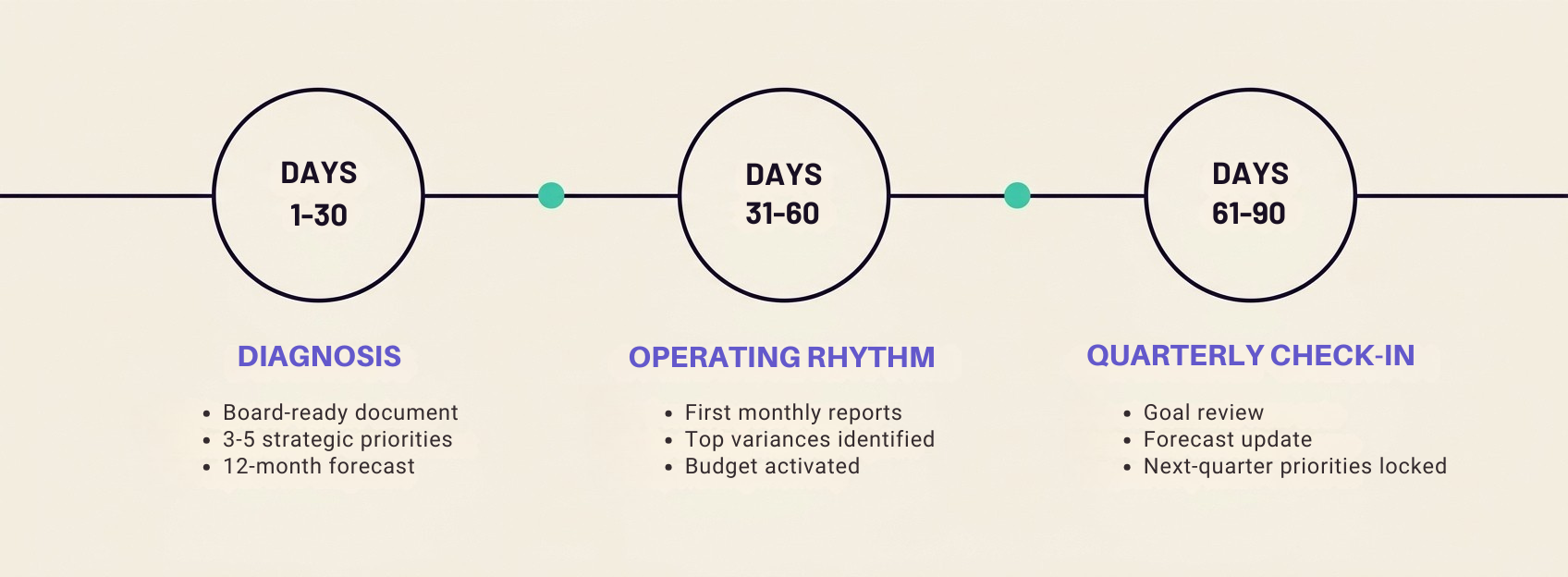
ABA CFO Services are designed so you start seeing decisions improve almost immediately. Here's what the first quarter looks like in practice:
Days 1–30: Diagnosis. We pull your last 9 months of data, build the full diagnosis, and present it back to you as a working session. You leave with a board-ready document, a ranked list of 3–5 priorities, and a 12-month forecast.
Days 31–60: Operating rhythm begins. Your first Monthly Financial Report, Budget vs Actuals, and KPI Report land. We meet to walk through the numbers, identify the top 1–2 variances, and agree on what changes for the next 30 days. The budget is now your steering wheel, not a forgotten spreadsheet.
Days 61–90: First quarterly check-in. We sit down for 90 minutes, review every goal from the diagnosis, update the forecast based on the first two months of actuals, and lock the top 3 priorities for the next quarter. Every decision is documented and owned.
By day 90, you have everything a best-in-class CFO partnership delivers: a baseline you understand, a monthly rhythm that catches problems early, and a quarterly forcing function that keeps the plan honest.
Real Findings We've Surfaced for ABA Practices
To make this concrete, here are three findings we've delivered to ABA owners, each one representing material money on the table that wasn't visible before:
FINDING #1 - The hidden $200–300K EBITDA opportunity
A practice generating a 20% net profit margin on $2.62M in billed revenue with strong client growth, but payroll at 72.6% of revenue and monthly billing volatility (collections ranging 26%–193% of billings) pointed to a clear path: a clinic-based hybrid model and weekly billing cadence could lift EBITDA by $200K–$300K annually.
FINDING #2 - A cancellation rate hiding $155K in lost revenue
Cancellation rate hit 31.8% in one month - more than 2× the 15% benchmark. At the practice's billing rate, those 1,555 cancelled hours represented roughly $155K in lost revenue. The owner hadn't been tracking the metric monthly. Root cause analysis (provider vs. client vs. other) became the immediate priority - the single largest revenue-leakage lever available.
FINDING #3 - Three KPIs flashing the same signal
Three operational KPIs flashed red in the same month: cancellation rate at 31.8% (benchmark <20%), schedule efficiency at 68.2% (benchmark ≥85%), and authorization utilization at 44% (benchmark 70–80%). These weren't three problems - they were one problem showing up in three places. The practice was delivering only ~44% of the hours it was authorized to deliver. A clinic-based delivery option addressed all three KPIs simultaneously.
None of these findings came from a one-off audit. They came from the monthly rhythm and ABA-specific benchmarks that ABA CFO Services are built around.
How ABA CFO Services Fit With the Flychain Platform
The Flychain platform gives healthcare practice owners a complete financial foundation. Every Flychain customer gets bookkeeping built for healthcare, the CFO Hub suite of intelligence tools, and access to Capital as standard. Taxes and ABA CFO Services are add-on modules layered on top.
Flychain's CFO Hub is where the intelligence lives. It includes tools that give you real-time visibility into your practice's economics:
- Flychain AI. Built exclusively for healthcare practices. Analyzes your financials in real-time, compares you to industry benchmarks, identifies opportunities for improvement, and provides strategic guidance - like having a financial advisor on call 24/7.
- Contracted Rate Analysis. Compare your contracted rates for each CPT code to other providers in your state. Identify rate negotiation opportunities and understand where you're leaving money on the table.
- Specialty Benchmarking. See how your financial metrics stack up against similar providers in your specialty. Find inefficiencies and areas for improvement based on real data from hundreds of practices.
- Salary Benchmarking. Benchmark hourly pay, annual pay, and bonus compensation for every role in your organization by state. Make data-driven compensation decisions and stay competitive.
- Valuation Services. Use the platform to perform a real-time valuation of your practice based on your actual financials. Schedule a comprehensive valuation with our M&A partner for deeper analysis.
Flychain's ABA CFO Services sit on top of all of that as an ABA-specific add-on module, powered by Blueprint Behavioral Advisors: a fractional CFO team built specifically for ABA practices.
Together, Flychain and Blueprint deliver something neither could deliver alone:
- Flychain provides the financial operating platform: bookkeeping, accurate financial statements, the CFO Hub's intelligence tools, and the rest of the standard Flychain stack.
- Blueprint Behavioral Advisors provides the dedicated CFO services who delivers the diagnosis, leads the monthly walkthroughs, sets and reviews the budget, builds the KPI commentary, and runs the quarterly strategy sessions.
What you're getting is an ABA-specialist CFO who knows your practice inside and out, supported by the financial infrastructure that makes their work possible.
Not software pretending to be a CFO. Not a generalist firm that took on a few ABA clients and called themselves specialists.
That combination is what makes Flychain's Full-Service CFO distinct.
If you're already on Flychain, adding the Full-Service CFO module is a single conversation
Start With a Free Strategy Call
We've built Flychain’s ABA CFO Service because we believe ABA practice owners deserve a full-service CFO who actually understands what they're running.
The best way to see whether ABA CFO Services are right for your practice is to start where every Flychain ABA engagement starts: with a free strategy call.
On a 30-minute call, Flychain's ABA CFO Advisor will:
- Walk through your current financial picture against ABA benchmarks.
- Identify the top 2–3 areas where money is most likely leaking today.
- Show you what a full diagnosis would surface and what 90 days of ABA CFO Services would look like for your practice specifically.
There's no commitment, and there's no generic sales pitch. Just a real conversation about your numbers with a CFO who's spent hundreds of hours inside ABA P&Ls.
Book your free strategy call here →
Frequently Asked Questions
What's the difference between ABA CFO Services and a general fractional CFO?
A general fractional CFO will build you a P&L, a budget, and a cash flow forecast, but the benchmarks they use, the KPIs they prioritize, and the strategic recommendations they make are built for businesses in general.
Flychain's ABA CFO Services are delivered by Blueprint Behavioral Advisors, a fractional CFO team that works exclusively with ABA practices, and they're built specifically around ABA economics: setting-aware benchmarks (in-home vs. clinic vs. hybrid), authorization utilization tracking, cancellation rate as a primary KPI, payer concentration analysis, and quarterly check-ins designed around the strategic decisions ABA owners actually face.
Do I need to be a Flychain customer to access ABA CFO Services?
Yes. ABA CFO Services are an add-on module to the Flychain platform - alongside Taxes, which is also an add-on. Every Flychain customer gets bookkeeping, the full CFO Hub (Contracted Rate Analysis, Specialty Benchmarking, Salary Benchmarking, Valuation Services, and Flychain AI), and access to Capital as standard.
If you're already a Flychain customer, adding ABA CFO Services is a single conversation. If you're new to Flychain, you'd be onboarded onto Flychain first to get access to the ABA CFO Services.
How much do ABA CFO Services cost?
Pricing is set during the free strategy call based on your practice size, complexity, and which deliverables you need most.
We are size pricing so ABA CFO Services pay for themselves within the first 6 months. Most ABA practices have at least one revenue-leakage issue (cancellation rate, authorization utilization, payer mix, or A/R aging) that the diagnosis alone identifies.
What if I'm not sure I'm ready for a full CFO engagement?
That's exactly why we built the free strategy call as the first step. You'll get a clear read on where your practice stands today, the top 2–3 opportunities specific to your numbers, and a concrete sense of whether the monthly rhythm of ABA CFO Services would be worth it for your practice. If it's not the right fit, you walk away with the conversation and no commitment.
Who is Blueprint Behavioral Advisors?
Blueprint Behavioral Advisors is the fractional CFO team that powers Flychain's ABA CFO Services.
They specialize exclusively in ABA practice economics: the payer dynamics, workforce structures, authorization mechanics, and operational levers that define how ABA practices actually make money.
Flychain partnered with Blueprint specifically because we wanted the human side of the offering - the CFO who walks you through your numbers - to come from a team with deep, narrow expertise in ABA, not a generalist firm that happens to take ABA clients.
Who delivers the fractional CFO work: software or a person?
Both, working together. You get a dedicated ABA CFO from Blueprint Behavioral Advisors who delivers the diagnosis, walks you through every monthly report, leads quarterly strategy sessions, and is your point of contact.
Flychain's underlying platform handles the bookkeeping, financial reporting, dashboards, CFO Hub intelligence tools, and KPI tracking infrastructure that make the CFO work possible.
This is not a self-serve dashboard with a chatbot: it's a real CFO partnership, built on top of the financial operating system that makes CFO-grade work affordable for independent ABA practices.
How quickly can we get started on Flychain's CFO Services?
The free strategy call can typically happen within a week of reaching out. If you choose to move forward, the full Initial Financial Diagnosis is typically delivered within 30 days of onboarding, and the monthly operating rhythm begins the following month.
Flychain is the financial operating system for independent healthcare practices - bookkeeping, CFO intelligence, taxes, and capital, built for ABA, home health, and behavioral health providers. Learn more at flychain.us.