.png)
ABA CPT codes are the billing codes used to report assessments, direct treatment, protocol modification, caregiver guidance and group ABA services. The main Category I codes are 97151–97158, while 0362T and 0373T apply to certain more complex services. Most are billed in 15-minute units, with reimbursement affected by the service, provider credentials, modifiers, payer and location.
Why ABA Reimbursement Rates Are Worth a Closer Look
If you run an ABA practice, you already know the ABA CPT codes by heart. You bill 97153 every day, you fight over 97155 supervision time, and you have opinions about how payers handle 97156.
What most practice owners don't have is a clear answer to a much harder question: when an insurer hands you a fee schedule, are those numbers any good?
That blind spot costs money. We recently pulled published reimbursement data for hundreds of ABA providers across three Midwestern states, and the pattern was hard to ignore.
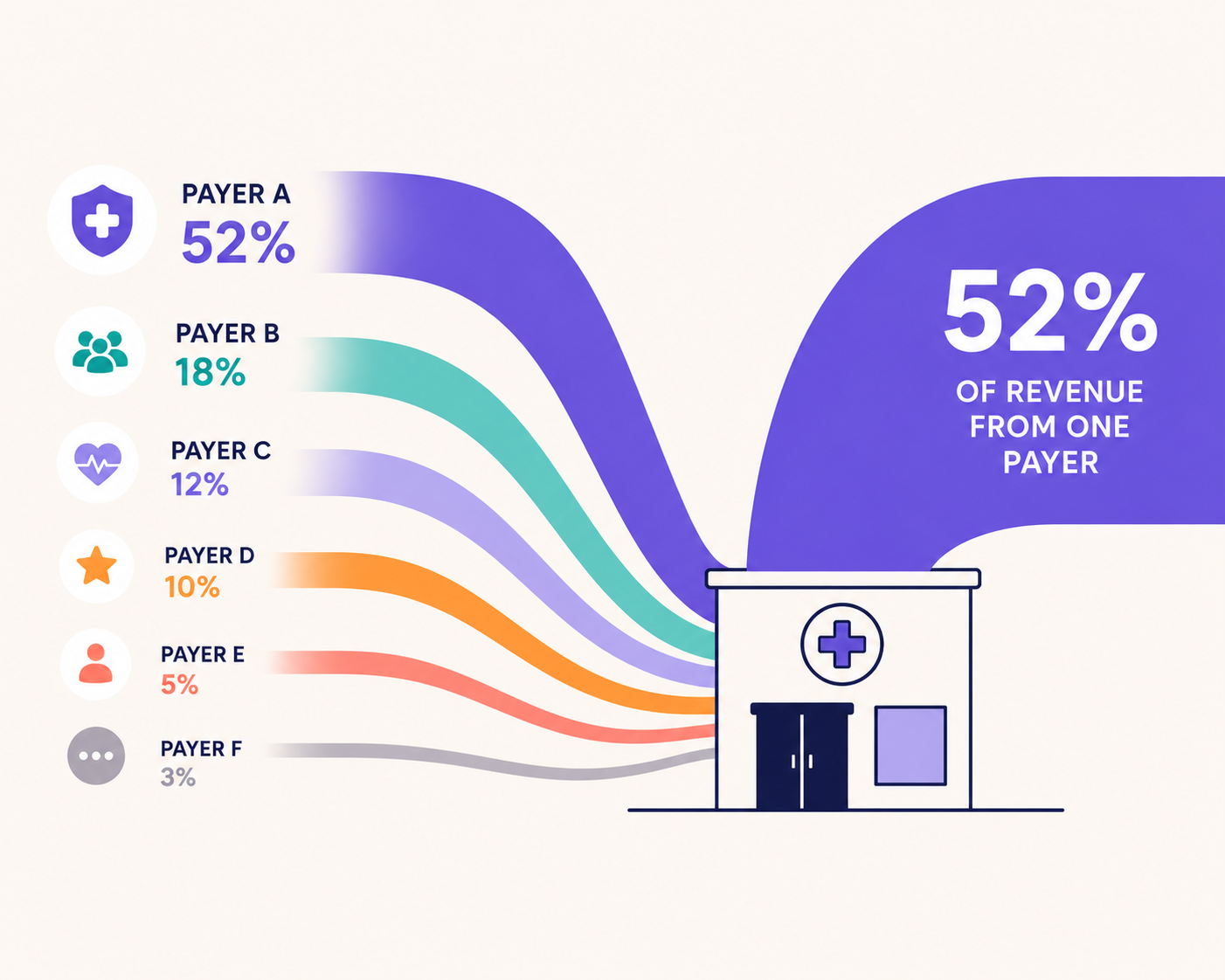
Nearly two-thirds of practices were sitting on the exact rate floor the payer offers by default. They had never negotiated, and most had no idea there was room to.
In this guide, you'll learn:
- What each ABA CPT code means
- The modifiers that change reimbursement
- Real UnitedHealthcare reimbursement benchmarks
- How to know if you're underpaid
- How to negotiate higher contracted rates
Free download: ABA CPT Code & Reimbursement Cheat Sheet. A one-page reference with all the core codes, the modifier tiers, the UHC-family rate bands (KS/OK/MO), and five billing watch-outs - built to keep next to your desk. Download the cheat sheet here.
At Flychain, we handle the financial back office for ABA and behavioral health practices, and rate benchmarking - within our Flychain CFO Hub - is a core part of that work.
We're not billing experts in the credentialing sense, and we'll flag where you should confirm details with your biller. But we do spend our days inside payer rate data, and a lot of what we see surprises owners.
If you want the bigger picture on practice economics first, our complete guide to healthcare practice financing options is a good companion to this one.
The Data: Most ABA Practices Are Paid the Same Floor Rate
From our analysis of published UnitedHealthcare-family rate data across Kansas, Oklahoma, and Missouri
- 216 ABA provider organizations analyzed
- 3,400+ reimbursement rate filings reviewed
- 3 U.S. states (Kansas, Oklahoma, Missouri)
- ~64% of practices were paid the payer's default floor rate - the same across direct therapy, supervision, and family guidance (97153, 97155, 97156)
- Up to 47% difference between the lowest and highest rate for the same code, modifier, and region
Want to see if you’re leaving money on the table?
Get a free financial assessment from our healthcare accounting experts.
ABA CPT Codes Explained: The Codes That Drive Your Revenue
Before benchmarking anything, the team needs a shared vocabulary.
The ABA CPT codes below are the workhorses of nearly every applied behavior analysis claim. They're part of the adaptive behavior services code set maintained by the American Medical Association, which assigns and defines all CPT codes.
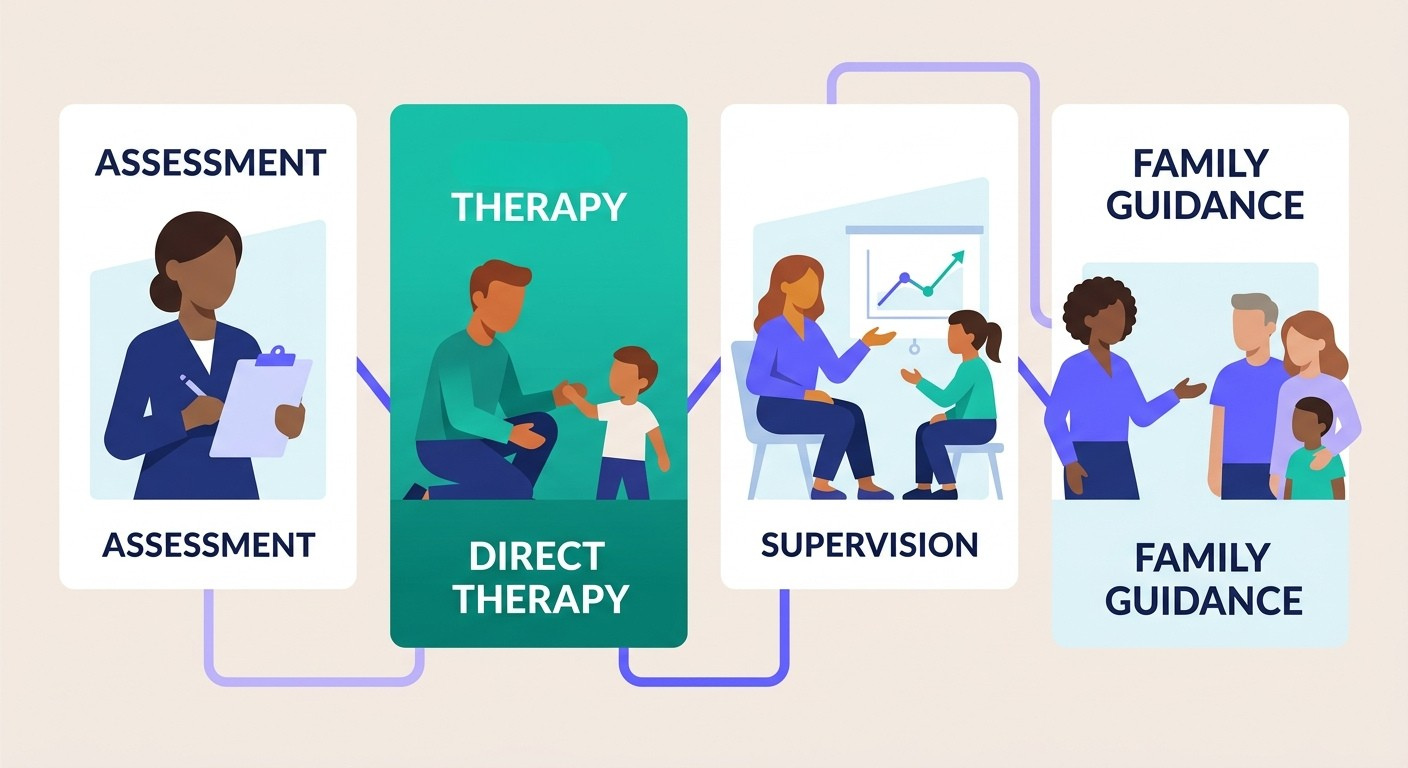
Three of them, 97153, 97155, and 97156, make up the bulk of billed hours, so we'll spend most of our time there.
The ABA billing codes you use most often are also the ones where small rate differences compound into real annual dollars.
97151: The Assessment Code
The 97151 CPT code description covers behavior identification assessment: the structured evaluation a qualified provider performs to build a treatment plan. It's billed in 15-minute units like the other codes. Unlike most ABA codes, 97151 may include billable non-face-to-face work associated with the assessment, such as scoring, interpretation, and report preparation, subject to payer policy. It usually appears at intake and at reauthorization points, not daily.
Because it's front-loaded in the client relationship, it tends to fly under the radar in rate reviews, which is a mistake. Assessment rates vary widely between payers.
97153: Direct Therapy, Your Highest-Volume Code
The 97153 CPT code description is adaptive behavior treatment by protocol: the direct one-on-one adaptive behavior treatment typically delivered by a behavior technician under a qualified healthcare professional’s treatment plan. This is the code that fills your schedule.
For most ABA practices, 97153 represents the largest single share of billed units, which means its reimbursement rate has more impact on your revenue than any other line on the fee schedule. A 10% difference here is not a rounding error; it's the difference between a healthy month and a thin one.
97155: Protocol Modification and Supervision
The 97155 CPT code describes adaptive behavior treatment with protocol modification. It is used when a BCBA or other qualified healthcare professional is directly involved in treatment and actively modifying the protocol based on the patient’s performance and clinical presentation. This often occurs while a technician is delivering therapy, but the defining feature is the protocol modification - not supervision itself.
This is a qualified healthcare professional (typically a BCBA)-delivered service. That credential requirement matters for billing and, as we'll see, for which modifier you attach. Under the modifier convention discussed in this guide, 97155 is billed as a qualified healthcare professional service rather than at a technician credential level.
97156: Family Guidance
97156 is family adaptive behavior treatment guidance: a qualified healthcare professional (typically a BCBA) works directly with caregivers so the family can reinforce skills at home. Like 97155, it's typically BCBA-delivered.
Although caregiver training is clinically important, reimbursement policies for 97156 vary across payers. The benchmark data later in this guide can help you understand where your contracted rates fall.
Not sure which of your codes is underperforming? Flychain benchmarks your contracted rates against published payer data so you can see exactly where you stand. Book a free exploration call.
ABA Modifiers: Why the Same CPT Code Can Pay Different Rates
Here's where many practices lose money without realizing it. The same CPT code can reimburse at very different rates depending on the credential of the person delivering the service, and that credential is communicated through ABA modifiers.
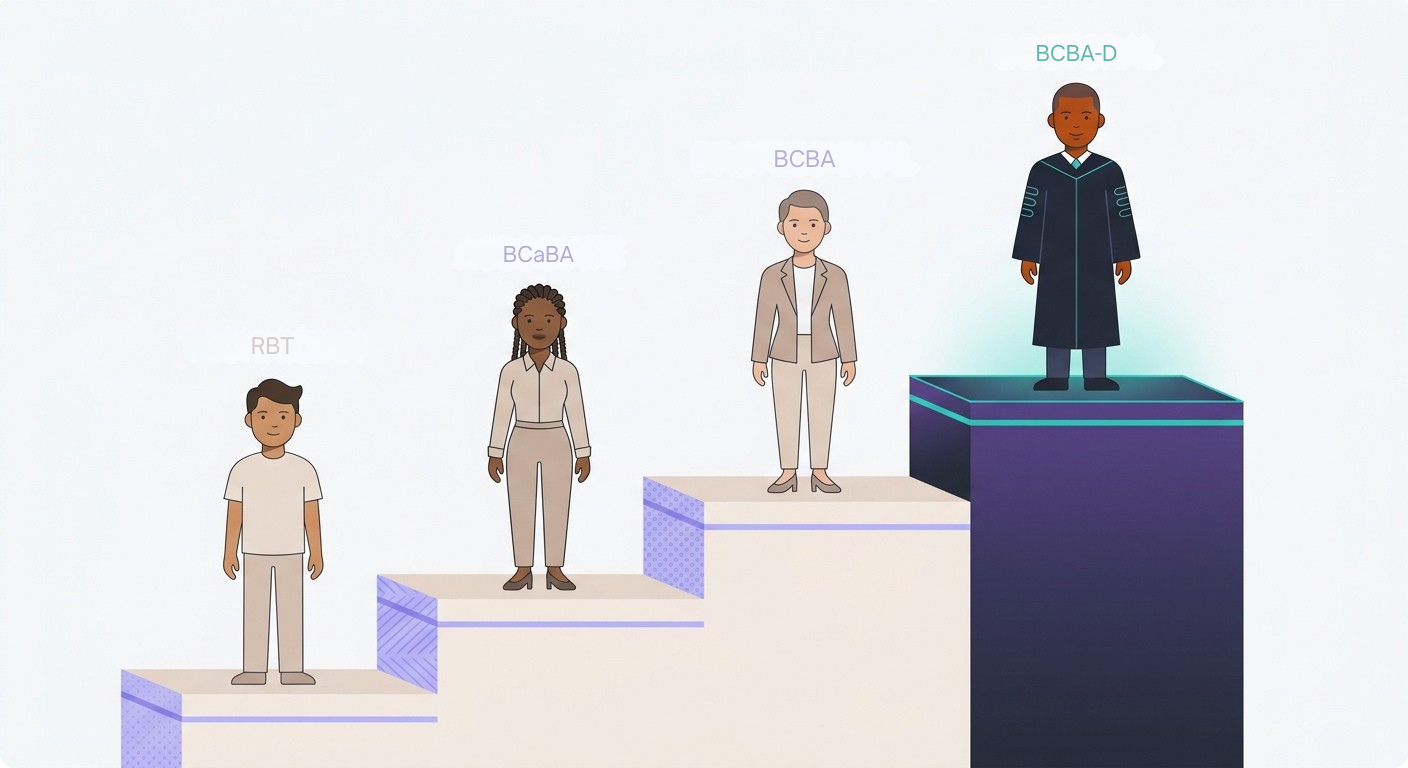
Many commercial ABA payers use H-series modifiers to distinguish provider credentials and, in some cases, reimbursement tiers. However, exact tier definitions can vary by payer; the mapping below follows the UnitedHealthcare/Optum convention.
The credentials behind these tiers - RBT, BCaBA, and BCBA - are defined and certified by the Behavior Analyst Certification Board.
Two practical points come straight out of this:
- For many commercial payers, higher credential levels are reimbursed at higher rates, making accurate modifier selection important to avoid underpayment. Under-coding the modifier can quietly suppresses your reimbursement.
- Under the UnitedHealthcare/Optum convention, 97155 and 97156 do not have an HM tier because they are delivered by a qualified healthcare professional rather than a technician. As such, if you ever see an HM rate attached to those codes for UHC, something is wrong.
This is also why quoting a single ‘average ABA rate’ can be misleading. Without stratifying by modifier, technician- and doctoral-level reimbursement are blended together, making comparisons much less useful. That’s why the next section breaks rates out by modifier.
Not every payer uses these modifiers - or reimburses them differently - but understanding them is essential when analyzing commercial ABA contracts.
What UnitedHealthcare Actually Pays: ABA Reimbursement Rates by Code and Modifier
We pulled published Transparency in Coverage rates for the UnitedHealthcare family of plans, which includes UHC, Optum, and PacifiCare, across 216 ABA-billable provider organizations in Kansas, Oklahoma, and Missouri.
The data covers more than 3,400 individual rate filings. To protect provider confidentiality, everything below is aggregated into ranges; no single practice's rate is identifiable.
The headline finding is the spread. For every code and modifier, there's a hard floor that a large share of practices sit on, and a ceiling, up to 47% higher, that a minority have negotiated their way to. Here are the pooled rate bands.
97153 (Direct Therapy) Reimbursement Bands
97155 (Supervision) Reimbursement Bands
97156 (Family Guidance) Reimbursement Bands
Look at the 97153 HN row. The floor is $14.18. The ceiling is $20.90. That's a 47% difference for the same code, same modifier, same payer family, same region. The practices at the top didn't get lucky; they negotiated.
And here's the part that should get your attention: the median is also $14.18 - identical to the floor. That's not a coincidence.
It happens because 64% of the practices in our sample were paid the exact same rock-bottom rate for 97153 at the bachelor's tier. When most of a market sits on one number, that number becomes the median.
The payer's default rate isn't a starting point most practices improve on - for the majority, it's simply where they stayed.
You'll see the same pattern across the other codes and tiers: the median lands at or very near the floor, because the floor is where most practices are clustered. The ceiling shows what's achievable. The gap between them is the opportunity.
If those numbers feel low for the work involved, you're not wrong, and it's part of a broader margin picture worth understanding. Our introduction to healthcare accounting walks through how reimbursement rates flow into the financial health of a practice.
Methodology: These figures come from published Transparency in Coverage data for the UnitedHealthcare family of plans (UHC, Optum, and PacifiCare), covering 216 ABA-billable provider organizations across Kansas, Oklahoma, and Missouri. Rates were reduced to one rate per practice for each code-and-modifier combination, then pooled across the three states. "Floor," "median," and "ceiling" refer to the lowest, median, and highest rate observed across practices within each group. All figures are aggregated to protect provider confidentiality; no individual practice's rate is identifiable. Rates reflect commercial plans only (not Medicaid or Tricare) and were current as of the data pull. Because Transparency in Coverage files update over time and self-funded plans may deviate from the standard commercial schedule, treat these as directional market benchmarks rather than guaranteed rates.
From Flychain's perspective
Rate benchmarking like this is core to our work with ABA practices, and the pattern above is one we see again and again. When we pull a practice's published rates and compare them to the market, we consistently find:
- Most practices are sitting at or near the payer's floor - the default rate, accepted as-offered.
- Very few have ever formally requested an increase - the floor wasn't chosen over alternatives; it was simply never tested.
- The practices earning the ceiling rates are the outliers - and they got there by negotiating, not by luck.
The rate gap is rarely the problem owners expect, and almost always bigger than they assume.
Closing that gap is one input into a much bigger financial picture - which is exactly what a dedicated ABA CFO tracks month over month, not just at contract renewal.
How to Tell If You're Sitting on the Floor
You don't need a data pull to run this check. You need your current fee schedule and ten minutes. Here's the process we use.

- Pull your contracted rates for 97153, 97155, and 97156, broken out by modifier (HM, HN, HO, HP). Your billing system or your payer contract has these.
- Line them up against the floor column in the tables above for the matching code and modifier.
- If your rate equals the floor almost exactly, that's the payer's default. It strongly suggests the contract was signed as offered, with no negotiation.
- If you're between the floor and the median, you have room. If you're near the ceiling, you've done well; protect it at renewal.
One caution: these bands are specific to the UnitedHealthcare family in three Midwestern states, and they reflect commercial plans, not Medicaid or Tricare.
Your market and payer mix will differ. But the ABA billing codes and modifier structure are national, so the method travels even when the exact numbers don't.
And remember that self-funded plans administered through UMR often follow the underlying UHC commercial schedule, but not always, so treat any single benchmark as directional rather than gospel.
Flychain pulls your actual published rates, stratifies them by code and modifier, and shows you exactly how far below the ceiling you're sitting, with the competitor benchmarks to back it up at the negotiating table. See where your practice stands.
Free download: ABA CPT Code & Reimbursement Cheat Sheet. A one-page reference with all the core codes, the modifier tiers, the UHC-family rate bands (KS/OK/MO), and five billing watch-outs - built to keep next to your desk. Download the cheat sheet here.
5 Common ABA Billing Mistakes That Cost Practices Money
Knowing the codes and your rates is half the battle. The other half is getting the claim out the door correctly, and a handful of predictable errors quietly drain revenue from otherwise healthy practices.
We're not billing experts, and your biller or RCM partner should be your source of truth here, but these are the patterns worth knowing so you can ask the right questions.
1. The wrong modifier; or none at all.
For many payers, reimbursement depends on the credential modifier submitted with the claim. An incorrect or missing modifier is one of the most expensive small mistakes in ABA billing.
Many commercial payers differentiate reimbursement based on modifier and provider credential. Missing or incorrect modifiers may result in lower reimbursement, claim rejection, or requests for correction depending on the payer. This means a claim that should have been paid at the BCBA rate quietly pays at the technician floor.
If your billing system doesn't append the correct modifier to every line automatically, you can be underpaid on every affected session, and recovering it means resubmitting each claim.
2. Documentation that doesn't match the code.
Clean clinical notes still fail the billing test if they don't capture what the payer needs: start and stop times, the services delivered, the treatment targets addressed, objective data collected, and the clinical work performed.
This is especially true for 97155 - see the next point. Vague language like "worked on goals" is an audit red flag; specific, measurable notes are what survive a review.
3. Billing 97155 when it should be something else.
What is CPT code 97155? 97155 is for adaptive behavior treatment with protocol modification. It requires the BCBA (or other qualified health professional) to be directly involved in treatment and to make clinically significant modifications to the treatment protocol based on the patient’s presentation and response during the session.
If the BCBA is only providing routine supervision, observing the technician, or discussing the case without actively directing treatment and making protocol modifications, 97155 may not be supported. The documentation should clearly describe what was modified, why the change was clinically necessary, and how it affected the course of treatment.
Claims that don’t adequately support protocol modification are at greater risk of denial or audit-related recoupment because the documentation doesn’t demonstrate the medical necessity for 97155.
4. Concurrent billing without checking the rules.
Concurrent billing rules are one of the most misunderstood areas of ABA billing.
A BCBA generally cannot bill overlapping time under both 97153 and 97155 themselves. However, many payers permit concurrent billing when an RBT is providing 97153 while the BCBA is simultaneously delivering medically necessary 97155 through active protocol modification.
Exact rules vary by payer and state, so practices should verify each payer’s policy before billing overlapping services.
5. Authorization gaps.
Nearly every ABA payer requires prior authorization, and assessments, ongoing treatment, and reauthorizations each carry their own requirements and renewal windows. Billing past your authorized units, or delivering services in the gap between a lapsed authorization and a renewal, leads to denials that are often unrecoverable.
Tracking authorized units against delivered units - by code - is one of the highest-leverage things a practice can do to protect cash flow.
None of these are exotic. They're the everyday friction points where ABA revenue leaks, and most are catchable with the right system and a billing partner who flags them before the claim goes out.
If several of these sound familiar, it's worth a closer look at both your billing workflow and your underlying contracted rates - the two compound on each other.

Why Your Plan Type Changes Which Rate Applies
Here's a wrinkle that trips up even experienced practice owners: the rate you've benchmarked may not be the rate that governs a given claim, because not every UnitedHealthcare member is on the same kind of plan.
Two clients can both hand you a UHC card and sit on entirely different fee schedules. The three plan structures to know:
- Fully insured commercial plans: Bought by an employer directly from the carrier. These are subject to state autism mandates and generally follow the published commercial rates you've been benchmarking against.
- Self-funded employer plans: The employer bears the claims risk and only rents the carrier's network and administration, often through UMR (UnitedHealthcare's third-party administrator arm). UMR claims frequently follow the underlying UHC commercial schedule, but not always, since a self-funded plan can negotiate its own terms. Treat a UMR rate as likely-but-not-guaranteed to match your benchmark.
- Behavioral health carve-outs: Many plans route ABA through a separate administrator rather than the medical carrier. Optum Behavioral is the common one inside the UHC family, but you'll also encounter Carelon, Lucet, and others. This is why your 97153 rate sometimes appears under a network name you didn't expect.
The carve-out point is the one that bites hardest, because a single practice can carry several different ABA rates at once, depending on which administrator sits behind each member's plan.
So when you pull your contracted rates to run the floor-versus-ceiling check from earlier, sort them by administrator, not just by payer name. A blended "UHC rate" hides exactly the variation you're trying to find.
The practical takeaway: when a family asks whether ABA therapy is covered by insurance, the honest answer depends on their specific plan, and so does what you'll actually be paid.
Knowing the plan type before you verify benefits saves you from budgeting against a rate that was never going to apply.
Is ABA Therapy Covered by Insurance? What Owners Should Know About the Payer Side
Practice owners aren't the only ones asking about money. Families ask too, and the question is ABA therapy covered by insurance lands in your intake inbox constantly.
The short answer is usually yes: all 50 states require some level of insurance coverage for autism services, and ABA is the most commonly covered intervention.
But coverage existing and coverage paying well are different things, and the gap between them is where your contracts live.
Whether ABA therapy is covered by insurance depends on the plan type. Fully insured commercial plans are subject to state mandates. Self-funded employer plans fall under federal rules and may route behavioral health through a carve-out administrator rather than the medical carrier, which is why your 97153 rate sometimes shows up under a behavioral health network name you didn't expect.
For families, the practical coverage question is about benefits and authorization. For you, the practical question is the contracted rate behind that coverage, which is exactly what this guide has been about.
If you're weighing whether to stay in network with a given payer at all, that's a financial modeling question as much as a clinical one. Our overview of healthcare practice financing options can help frame the tradeoffs alongside your rate data.
What Actually Happens in a Rate Negotiation
If the data has convinced you that you're sitting on the floor, the natural next question is what to do about it. Rate renegotiation is less mysterious than most owners assume, but it does follow a rhythm, and walking in unprepared is how good cases get declined.
It starts with evidence, not a request. Payers field rate-increase asks constantly and decline most of them reflexively, because most arrive as "our costs have gone up, please pay us more." That argument loses every time.
What moves the needle is a benchmark: showing that comparable providers in your market - same codes, same modifiers, same region - are being reimbursed meaningfully above your current rate.
That reframes the conversation from "you want more money" to "your rate for this provider is below market," which is a problem the payer has a reason to fix to keep adequate network coverage.
From there, the process tends to follow a predictable path:
- Submit a written request to your provider relations or network management contact, accompanied by the supporting benchmark data.
- Expect a review period that can stretch from a few weeks to a few months.
- Plan for a counteroffer, not a yes: Payers rarely grant the full ask on the first pass.
- Lead with your highest-volume codes, usually 97153, since a small per-unit gain there compounds across thousands of units a year far faster than a larger bump on a low-volume code.
- Know your leverage honestly: A practice with strong outcomes data, short waitlists, or coverage in an area the payer struggles to fill has a materially stronger hand than one without those things.
A few realistic expectations. Not every payer will move, and some contracts limit when rates can be revisited, so timing your request to the renewal or rate-review window matters.
You don't need to be a billing expert to start the conversation, but you do need defensible numbers, because the payer's first move is almost always to ask where your benchmark came from.
That's the entire reason this kind of analysis exists: to put a credible figure in your hand before you ask.
Want help building your benchmark before you approach a payer? We'll pull your published rates, compare them to your local market, and walk you through the numbers. Book a 20-minute call with our team.
Turning ABA CPT Codes Into a Better Contract
Knowing your ABA CPT codes is table stakes. The practices that thrive go one step further: they know what those codes should pay, and they walk into every contract conversation with that number in hand.
The data is clear that the default fee schedule is a floor, not a fair offer, and that most practices never test it.
So here's the question worth sitting with: when was the last time you compared your contracted rates against what your competitors are actually getting paid?
If the answer is never, or longer ago than you'd like to admit, you may be leaving real money on the table every single month, one 15-minute unit at a time.
Flychain does this analysis for ABA practices every day. We pull your published rates, benchmark them against your local competitors by code and modifier, and hand you the evidence you need to negotiate up.
If you're ready to find out whether you're on the floor or the ceiling, book a contracted rate analysis inquiry call with our team and stop guessing about your reimbursement.
ABA CPT Codes and Reimbursement: FAQs
What are the main ABA CPT codes?
The core ABA CPT codes are 97151 (assessment), 97153 (direct therapy by a technician), 97155 (protocol modification and supervision by a BCBA), and 97156 (family guidance by a BCBA).
In practical terms, the 97153 CPT code description covers daily one-on-one sessions, the 97155 CPT code description covers BCBA supervision and plan changes, and the 97156 CPT code description covers caregiver guidance.
Most practices also encounter 97154 and 97158 for group services. 97153 typically drives the majority of billed units.
What is CPT code 97153?
97153 is adaptive behavior treatment by protocol - the direct, one-on-one ABA therapy a technician delivers under a behavior analyst's plan, billed in 15-minute units. It's the highest-volume code in most ABA practices.
Can you explain the differences between ABA codes and other medical billing codes?
ABA codes work like other CPT codes but have a few distinctive features. Almost all of them are time-based, billed in 15-minute units rather than per visit, so the same code can generate several units in one session.
They also rely heavily on credential modifiers (HM, HN, HO, HP) that change the reimbursement rate based on who delivered the service - a structure most medical specialties don't use as systematically.
And many ABA codes are split by provider type, with technicians delivering direct therapy (97153) and BCBAs delivering supervision and family guidance (97155, 97156).
That combination of time-based units, credential tiers, and provider-specific codes is what makes ABA billing more intricate than typical office-visit coding.
What modifier does a BCBA use?
Under the UnitedHealthcare/Optum convention, a BCBA's services are billed with the HO modifier (master's level). A doctoral-level BCBA-D uses HP. Exact tier definitions vary by payer.
What do the ABA modifiers HM, HN, HO, and HP mean?
They signal the credential of the rendering provider, which sets the rate tier.
Under the UnitedHealthcare/Optum convention, HM is less than a bachelor's (behavior technician), HN is bachelor's level (RBT or BCaBA), HO is master's (BCBA), and HP is doctoral (BCBA-D).
Higher credentials reimburse at higher rates, and exact tier definitions vary by payer. 97155 and 97156 have no HM tier because they are BCBA-delivered.
What is a typical 97153 reimbursement rate?
In our three-state UnitedHealthcare-family sample, 97153 ranged from about $12.51 per unit at the HM floor to roughly $24.59 at the HO/HP ceiling.
At the HN (bachelor's) tier, the median rate was $14.18 per 15-minute unit - the same as the floor, because most practices were paid exactly that default rate.
Rates vary by payer, plan type, and region, so use these as directional benchmarks.
Is ABA therapy covered by insurance in every state?
All 50 states mandate some autism coverage, and ABA is the most commonly covered service. However, the depth of coverage, authorization requirements, and the contracted rates behind that coverage vary significantly by plan and payer.