.png)
AI adoption in ABA therapy: the headline numbers
If you run an ABA therapy practice, you've probably noticed that ChatGPT, Claude, and other AI tools have quietly become part of how clinic owners and BCBAs get work done. Drafting parent communications, summarizing meetings, organizing notes, working through staffing decisions, even sense-checking financial reports.
What you may not know is just how widespread it has become across the industry, and how the practices using AI compare financially to those that aren't.
That's the gap this report fills. We pulled anonymized and de-identified bookkeeping data from 100+ ABA therapy practices on Flychain.
The data covers more than a year of monthly P&L data from January 2025 through March 2026 to answer the questions ABA owners are actually asking: how many practices have adopted AI, how much they're spending, which tools they're using, and whether AI adoption shows up in their finances.
If you'd rather skip ahead and see how your own practice compares, you can book a free 30-minute consultation with the Flychain team anytime.
In the rest of this report, we'll cover what AI in ABA therapy looks like in the real world: the adoption rate today and the trajectory over the past year, what a typical practice spends per month, the ChatGPT-vs-Claude breakdown, the correlation between AI use and profitability, and how Flychain customers use AI inside our own platform.
The findings paint a clear picture: ABA practices are AI-curious, but most are still in the very early innings.
Headline findings
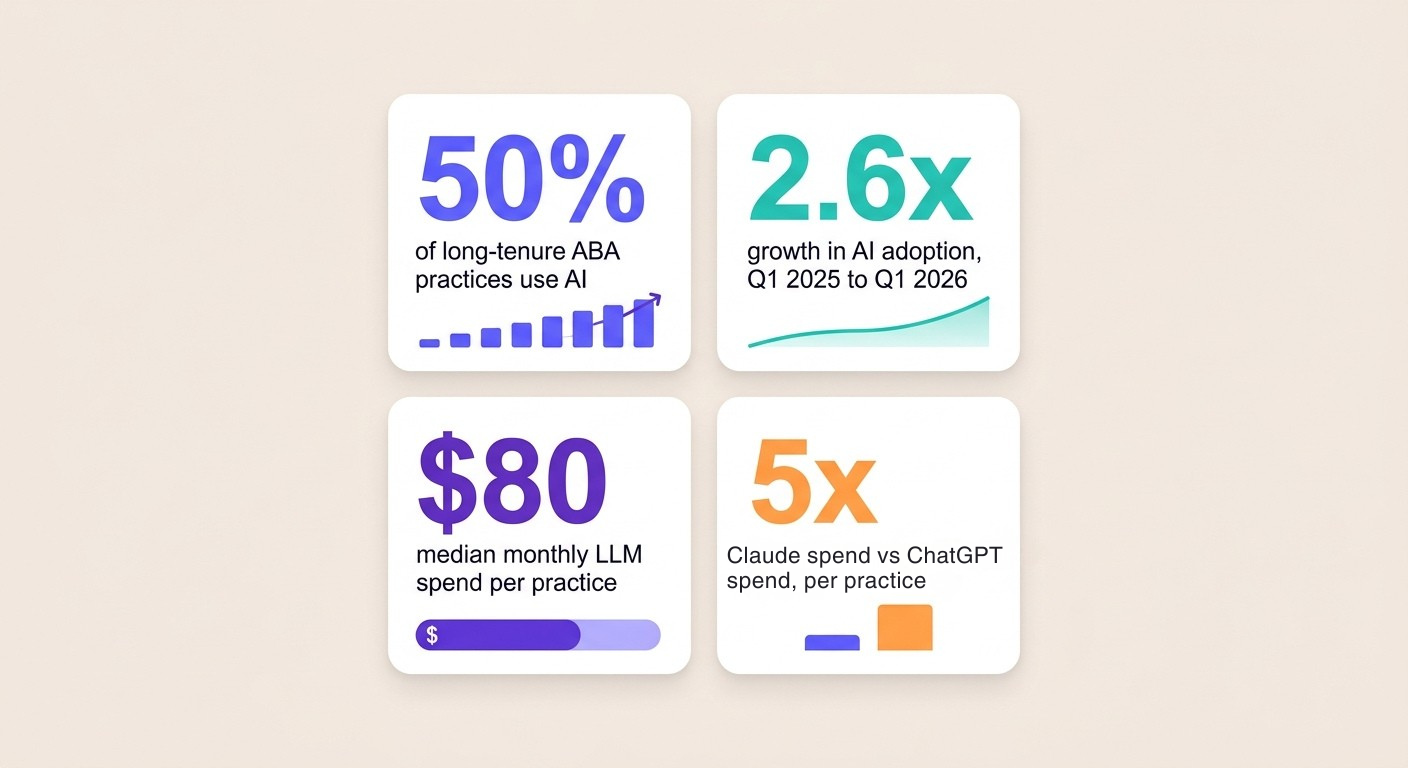
- AI adoption nearly tripled in twelve months. Among ABA practices on Flychain since January 2025, AI adoption rose from 19% in Q1 2025 to 50% in Q1 2026 - a 2.6× increase.
- Half of long-tenure ABA practices now use AI. By Q1 2026, 50% of practices in our same-store cohort had at least one ChatGPT or Claude subscription on their P&L.
- $80/month is the median monthly LLM spend among adopting practices - roughly 0.07% of revenue. Most practices are paying for one or two individual seats, not deploying AI across their teams.
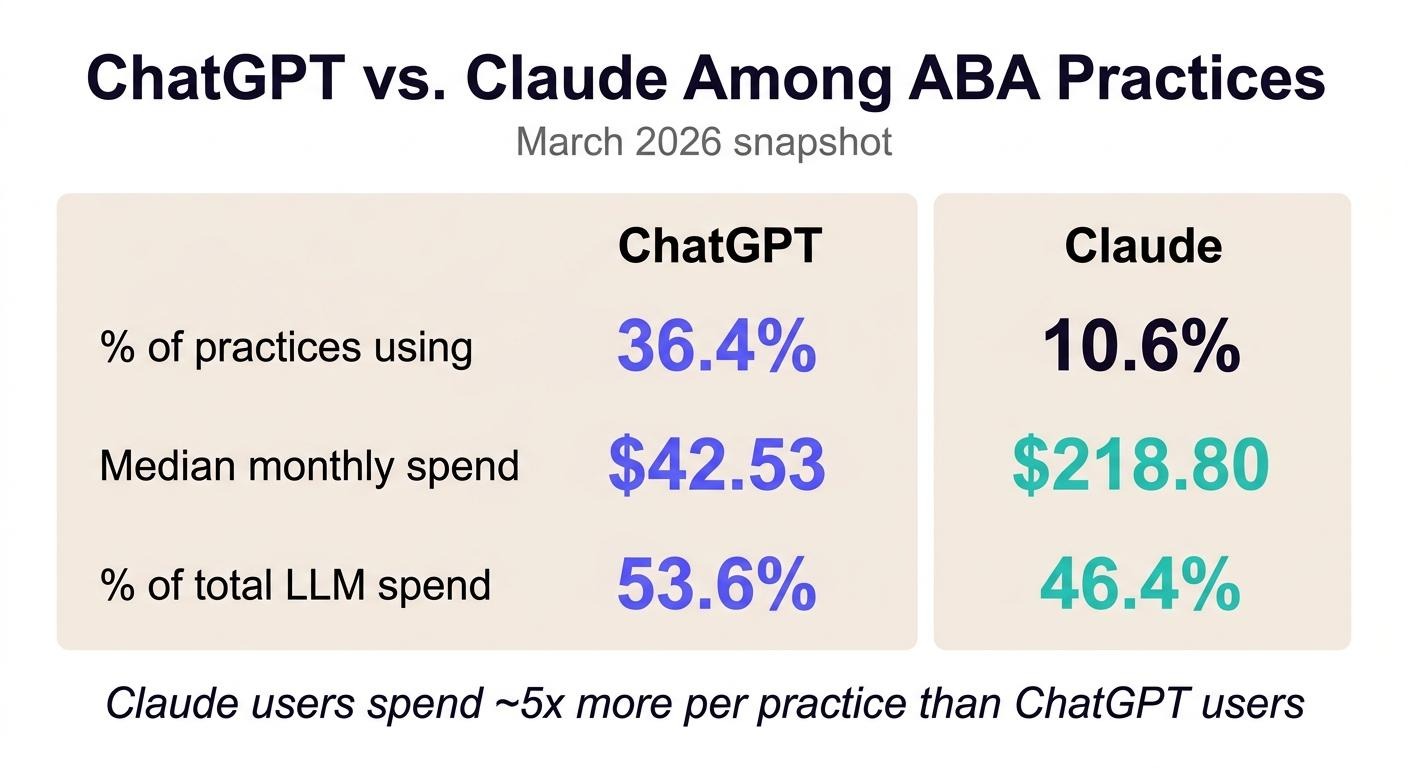
- ChatGPT leads adoption; Claude leads spend depth. More than 1 in 3 ABA practices use ChatGPT, while roughly 1 in 10 use Claude - but Claude users spend roughly 5× more per practice than ChatGPT users.
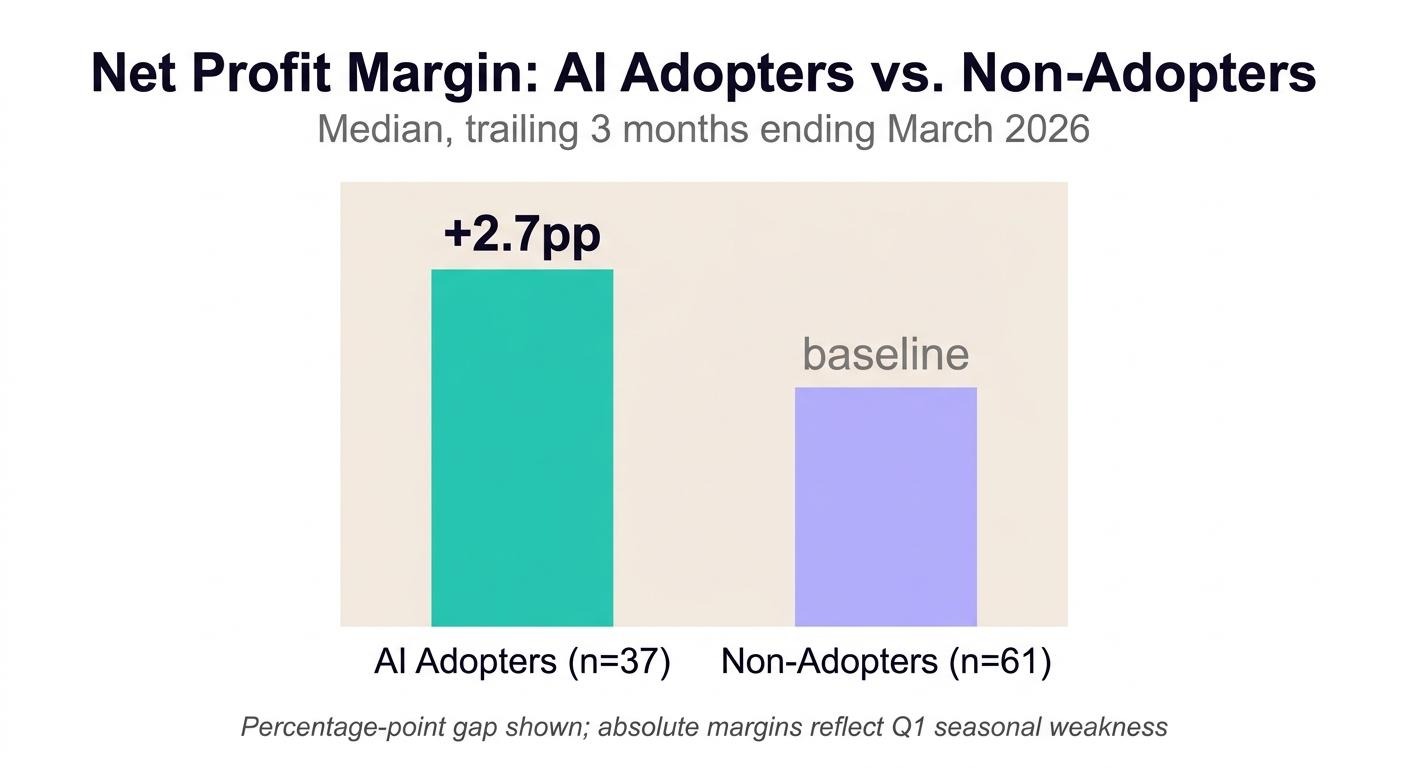
- AI adopters outperform non-adopters on profitability. Across Q1 2026 - a seasonally weak quarter for ABA practices - adopters outperformed non-adopters on net profit margin by approximately 2.7 percentage points.
Want to see how your practice's financials compare to the 100+ ABA practices in this report? Get a free consultation with the Flychain team and we'll walk you through where you stand on the metrics that matter most.
See our sister report, the 2026 ABA Practice Financial Benchmark Report, for a deeper look at target ABA financial benchmarks.
Want to see if you’re leaving money on the table?
Get a free financial assessment from our healthcare accounting experts.
Methodology: How we measured AI in ABA therapy
Before diving into the findings, we want to be transparent about how this analysis was done - because the methodology shapes how the numbers should be read.
Who's in the dataset
We started with all ABA therapy practices on Flychain's bookkeeping platform and filtered down to a qualifying cohort using these criteria:
- Practice type: ABA therapy practices only (no other healthcare verticals)
- Revenue threshold: average monthly revenue of $20,833+ (annualized ~$250k+)
- Internal entities excluded
That gave us over 100 qualifying ABA practices. The cohort is mid-market: the median practice has approximately $1.4M in annualized revenue, with two-thirds of practices falling between $500k and $3M ARR.
What counts as an AI tool
We scoped this report deliberately narrowly to general-purpose large language model (LLM) subscriptions. That means:
- Included: ChatGPT (OpenAI) and Claude (Anthropic) subscriptions
- Excluded: AI-adjacent tools like meeting recorders, voice generators, image generators, and ABA-specific software that has AI features as one component of a broader product
We made this choice for a simple reason: it's the only way to keep the methodology clean. The line between "an AI tool" and "a software tool with AI features" has become impossible to draw cleanly in 2026, and we'd rather report a tightly-scoped number that's defensible than one that might be double-counting.
We also excluded Microsoft Copilot and Google Gemini from this analysis because most Microsoft and Google charges in ABA practice P&Ls are for standard Microsoft 365 or Google Workspace subscriptions, not AI products. Separating the AI subscriptions from the productivity subscriptions wasn't possible at the categorization layer, so we left them out rather than risk inflating the numbers.
That means the AI adoption figures in this report should be read as a floor, not a ceiling. The true number of ABA practices using some form of AI is almost certainly higher.
Data sources and limitations
All data comes from monthly general ledger and income statement data flowing through Flychain's bookkeeping platform between January 2025 and March 2026. A practice is counted as having an AI subscription in a given month if at least one charge from a qualifying LLM vendor hit their P&L that month.
Two limitations worth disclosing upfront. First, recent months reflect only practices with closed books at time of analysis, so the late-period denominators are smaller than the underlying cohort.
Second, Q1 2026 is a seasonally weak quarter for ABA practices generally - school breaks, post-holiday authorization lags, and year-end accruals all suppress margins, which affects how the profitability comparison should be interpreted.
How many ABA practices use AI?
The headline number: 50% of ABA practices on Flychain since January 2025 had at least one ChatGPT or Claude subscription on their P&L in Q1 2026.
That's half of our long-tenure cohort - a meaningful share, especially for a tool category that didn't really exist three years ago.
But the more interesting story is how fast the number has moved.
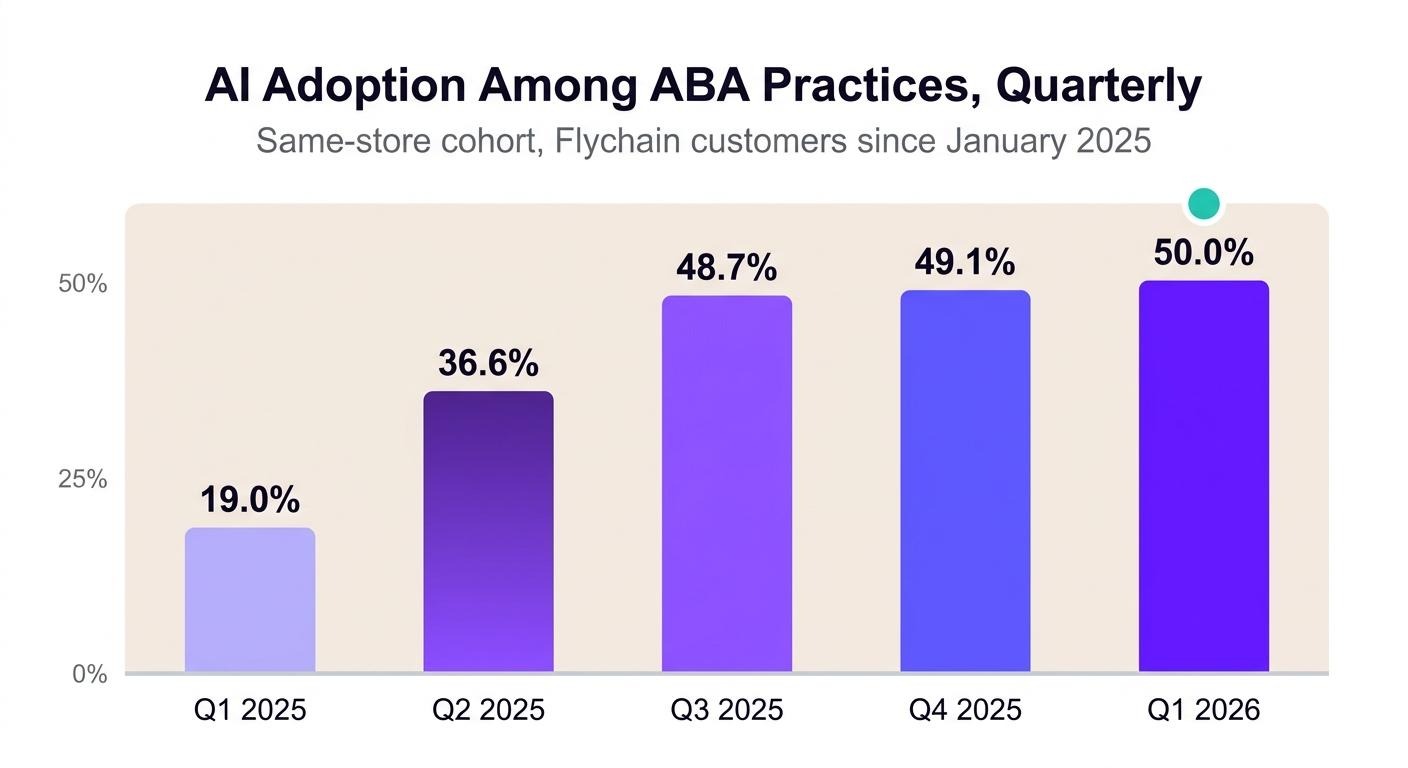
AI adoption in ABA therapy nearly tripled in twelve months
Looking at the same-store cohort - practices that have been on Flychain since January 2025, so we can compare apples to apples - AI adoption climbed from 19% in Q1 2025 to 50% in Q1 2026. A 2.6× increase in a single year.
We focus on the same-store cohort throughout this report because it gives the cleanest comparison: the same practices, measured at two different points in time.
A broader full-dataset cut tells a directionally similar story - across all qualifying ABA practices with closed books in March 2026, 41% had a ChatGPT or Claude subscription. However, this sample mixes longer-tenured practices with newer Flychain customers, which makes the trend over time harder to read.
Here's the quarterly progression:
The trajectory tells a clear story: adoption climbed rapidly through the first three quarters of 2025, then plateaued in the high-40s before nudging up to 50% in Q1 2026.
The plateau likely reflects two things: a natural saturation point for the early-adopter segment, and a real cohort of practices that haven't yet found a use case compelling enough to start paying.
Adoption is broadly distributed across practice sizes
We also looked at adoption rates broken out by practice revenue band.
The breakdown is roughly even across mid-market practices, suggesting that AI adoption in ABA therapy isn't being driven primarily by the largest organizations.
Owner-operators of $500k and $5M practices are adopting at similar rates.
This matters strategically: the wave of AI adoption in ABA isn't an enterprise IT rollout. It's an individual decision being made by clinic owners and BCBAs who pull out a credit card and start a subscription. Which directly shapes how much they're spending - the topic of the next section.
How much do ABA practices spend on AI?
Now the spend story. This is where the data gets even more interesting.
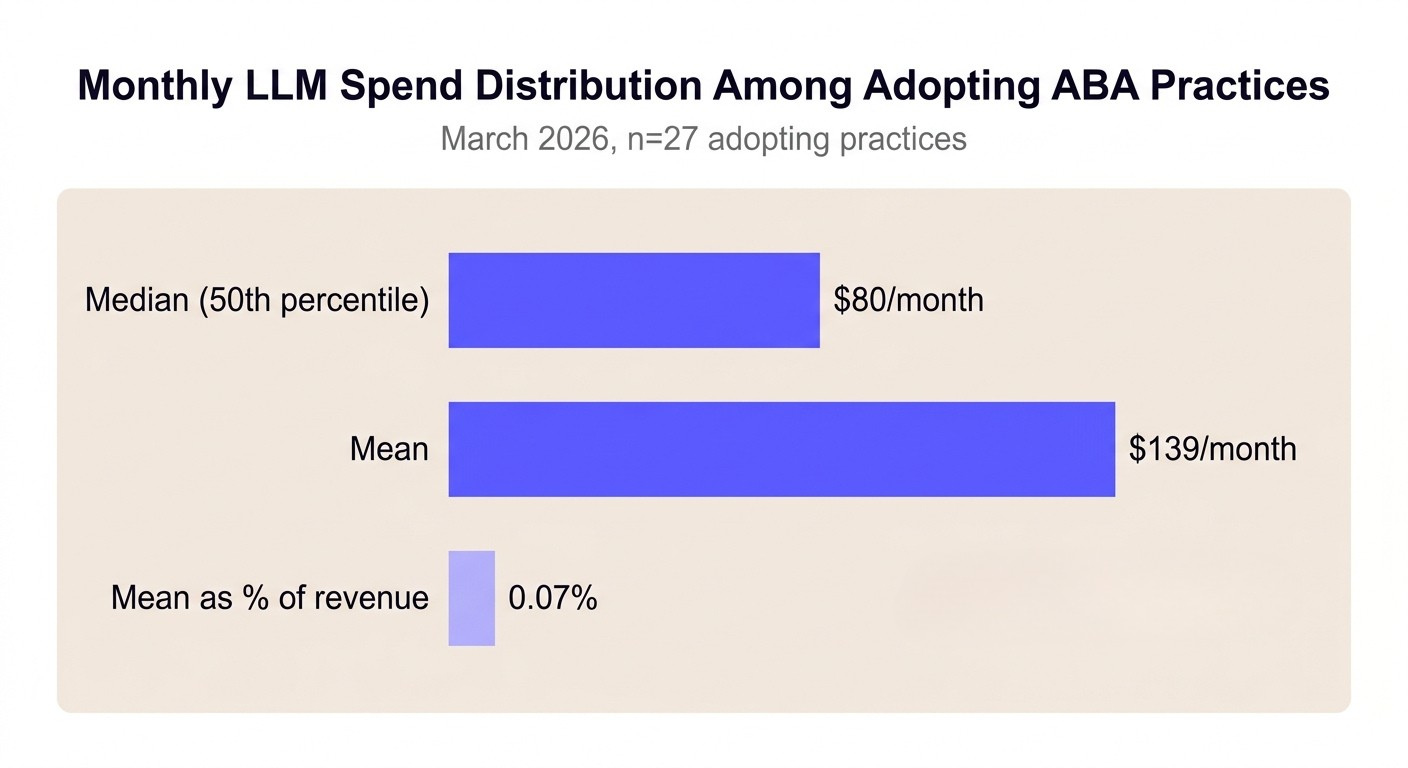
The typical adopting practice spends $80 per month on AI
Among the practices that have adopted AI, the median monthly spend in March 2026 was just $80.
The mean was higher at $139.57, pulled up by a small number of practices spending materially more. The distribution skews right: most adopting practices spend a little, a handful spend much more.
Spend metric (adopting practices, March 2026)
ABA practices are AI-curious, not yet AI-invested
Here's the interpretation that we think matters most.
Half of long-tenure ABA practices have adopted AI, but spend remains minimal. The typical adopting practice spends $80 per month, which is approximately 0.07% of revenue.
That's consistent with a single owner-operator running a ChatGPT or Claude subscription on their business card, not an organization-wide deployment.
In other words: ABA practices are AI-curious, but not yet AI-invested.
ABA practices are in the early stage of adoption where someone is asking AI questions a few times a week. This includes drafting a parent letter, summarizing a clinical document, working through a hiring decision, but not yet benefiting from agentic workflows where AI takes meaningful work off their team's plate.
That's not a criticism. It's the natural shape of a new technology category.
Adoption curves run ahead of spend curves by a year or two in almost every industry because people try a tool before they commit to building workflows around it.
The data here suggests ABA therapy is right at that transition point.
Curious about how Flychain customers are using AI to run their practices more efficiently?
See how Flychain's AI assistant helps ABA practices answer financial questions, find bookkeeping insights, and stay on top of cash flow.
ChatGPT vs. Claude: What ABA practices are actually paying for
When we look at which specific LLM subscriptions are showing up on ABA practice P&Ls, two names dominate: ChatGPT and Claude.
We confirmed no material spend on Perplexity, Gemini, or other general-purpose LLMs in the qualifying cohort, though as noted in the methodology, some Gemini and Copilot spend may be embedded in broader Google Workspace and Microsoft 365 subscriptions we couldn't cleanly separate.
ChatGPT leads on adoption; Claude leads on spend per practice
This is the most interesting split in the data, though it's also the section where we need to be most careful about how much weight to put on the numbers.
The Claude cohort in our dataset is small (n=7 practices), so the figures below are directionally meaningful but should be read as a preliminary signal rather than a precise estimate. We'll continue to publish updates to this report as the sample grows.
With that caveat in place, here's what the data shows.
ChatGPT is clearly the default LLM for ABA practices that have adopted AI: more than three times as many practices use ChatGPT as use Claude. But the practices using Claude are spending materially more per month and the explanation is straightforward once you look at how each product is actually priced.
Why ChatGPT spend stays low. ChatGPT Plus is $20/month per seat. The median ChatGPT subscriber in our dataset spends $42.53/month, which is consistent with one or two individual seats. This is exactly what you'd expect from an owner-operator running ChatGPT on their own account and maybe adding a second seat for a partner or admin lead.
Why Claude spend is higher. Claude has a tighter ladder of higher-tier individual plans than ChatGPT does. Beyond the $20/month Pro tier, Anthropic offers Claude Max at $100/month (5× usage) and $200/month (20× usage), aimed at power users who hit Pro's limits regularly.
The median Claude subscriber in our dataset spends $218.80/month - right at the Max 20× tier.
One likely explanation: ABA practices that adopt Claude tend to skip the entry-level subscription and go straight to a power-user plan.
This pattern is consistent with what we'd expect: Claude has positioned itself as the tool for heavy AI users (with deep document analysis, longer context windows, and Claude Code), so the ABA owners selecting it are often the ones already doing more sophisticated work with AI. Claude users are a smaller but more deeply engaged cohort.
But again, with only 7 Claude-using practices in this qualifying cohort, we'll need to watch this over the next few quarters to know whether the pattern holds.
Does AI adoption correlate with ABA practice performance?
This is the section we've been most careful about, because it's the section most likely to be misread.
The data shows that ABA practices using AI are running slightly higher net margins and slightly leaner admin labor cost ratios than non-adopters.
Both findings are real, both are directionally consistent, and neither should be interpreted as causal evidence that AI makes practices more profitable.
AI adopters run higher net margins
Looking at the trailing three months (January through March 2026), AI adopters posted median net margins approximately 2.7 percentage points higher than non-adopters.
We're using percentage-point gaps rather than the underlying margin figures here for one reason: Q1 is a seasonally weak quarter for ABA practices, and the absolute margin numbers for both groups reflect that seasonality rather than telling a clean story about typical profitability.
The same pattern holds for admin labor costs. AI adopters ran admin labor approximately 1 percentage point leaner than non-adopters across the same three-month window. Again, this is a directional finding, not a precise estimate.
Important caveats on interpretation
Before anyone takes these numbers and runs with them, three things worth keeping in mind:
- Correlation is not causation. Practices that adopt AI may already be more operationally sophisticated, more growth-oriented, or simply better-managed in ways that show up in financials regardless of whether AI is doing the work. The 2.7-point margin gap may be a signal of who the practice owner is, not what AI is doing.
- Q1 seasonality matters. ABA practices typically see weaker margins in Q1 due to school holidays, post-year-end authorization lags, and accrual timing. Both adopters and non-adopters look weaker in this quarter than they would in a full-year average.
- Sample size is moderate. The correlation analysis includes 37 adopters and 61 non-adopters. That's enough to identify a directional trend, but not enough to make confident claims about magnitude.
With those caveats in place, the directional finding still stands: ABA practices using AI are not, on average, running worse financials than practices that aren't.
If anything, they're running slightly better. Whatever effect AI is having on practice operations, the data does not support the worry that AI subscriptions are an expensive distraction.
How Flychain customers use AI inside our platform

Everything above measures third-party AI tools that ABA practices pay for on their own.
But Flychain customers also have access to AI inside our platform - and 42% of active ABA practices on Flychain have now used it. This is through our Flychain AI financial assistant for healthcare practices.
Flychain AI is built specifically for the questions ABA owners and CFOs ask about their books, cash flow, payroll, and tax position. Our analysis of how they use it gives us a uniquely clean window into what's actually on the mind of an ABA practice owner in 2026.
Since launch in early 2026, ABA therapy practices have generated 662 queries to Flychain AI across 52 unique practices. Usage is growing steadily, climbing from a handful of queries per week in January to a recent peak near 93 per week in mid-May.
The data in this section is pulled from Flychain AI usage logs rather than bookkeeping data, and reflects how Flychain's ABA therapy customers have engaged with the assistant since launch.
What ABA practices ask Flychain AI most often
Conversations with Flychain AI are getting longer and more iterative. Practices don't just ask a single question and leave. They dig in, ask follow-ups, and work through the answer across multiple messages.
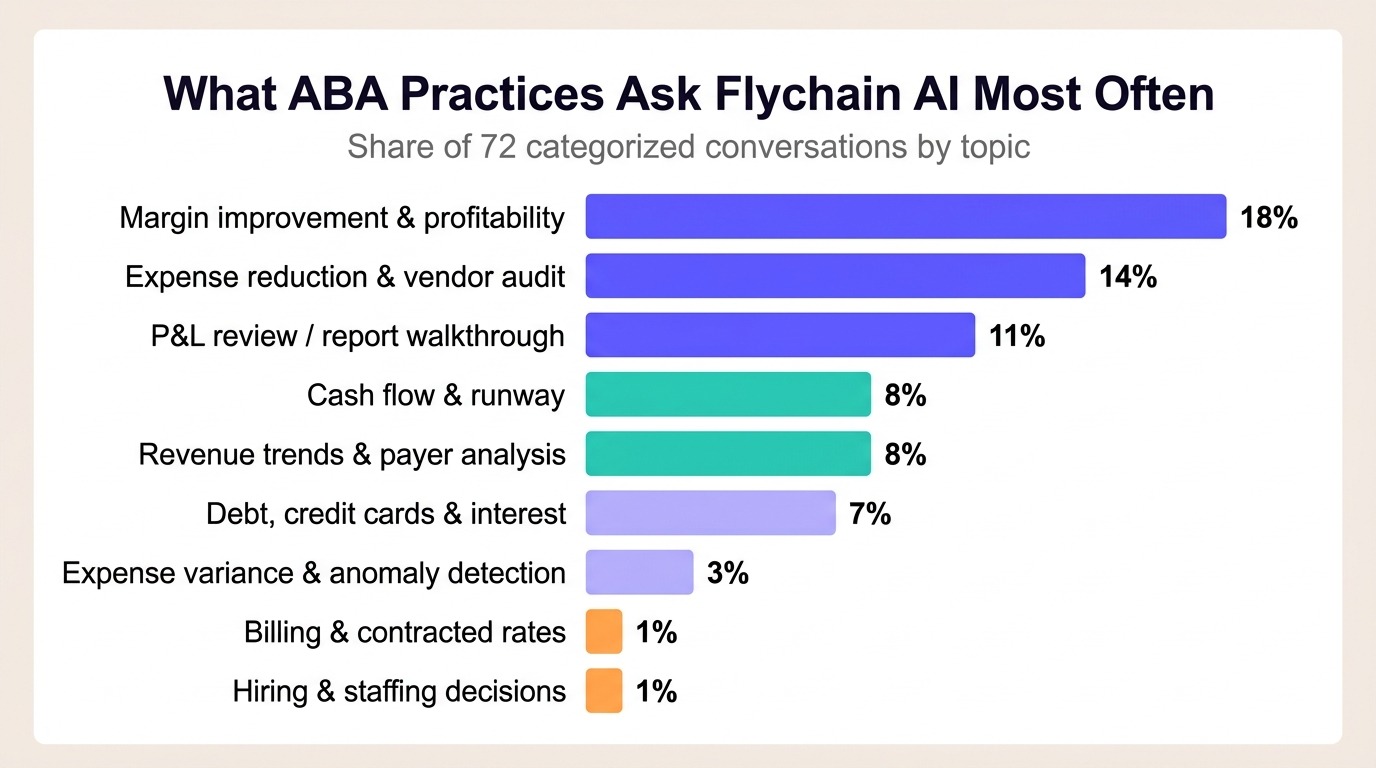
To understand what ABA owners are actually asking about, we categorized 72 of the most recent open-ended conversations - where users came with a specific question - and grouped them by topic.
A clear hierarchy emerges.
The single most common reason an ABA owner opens Flychain AI is to ask some version of one question: how do I make my practice more profitable?
Here's the full ranking of what ABA practices come to Flychain AI for:
What this tells us about the ABA practice owner mindset
Four observations stand out from the Flychain AI data.
First: profitability is the dominant concern.
Nearly 1 in 5 conversations starts with some version of "how do I improve my margin?" or "how do I make this business more profitable?"
Another 14% lead with expense reduction, which is just the other side of the same coin.
Together, profitability and expense management account for roughly a third of all conversations.
Second: ABA owners use AI to interpret their own data.
Eleven percent of conversations start with some variation of "give me the rundown of what's going on in this report". Practice owners are opening their P&L and asking Flychain AI to walk them through it.
That tells us a lot about where AI is delivering immediate value: not replacing financial analysis, but making it accessible to owner-operators who don't have a CFO.
Third: cash flow and debt are increasingly top-of-mind.
Cash flow, runway, debt, and credit card balances together drive 15% of conversations.
These aren't strategic profitability questions; they're tactical "can I cover payroll, what's my interest costing me, how should I sequence debt payoff" questions.
The fact that this many ABA owners are bringing these questions to AI suggests cash management is a real pressure point in 2026. We've written about this dynamic in depth - the cash flow problem nobody talks about for healthcare practices explains why reimbursement timing makes cash management uniquely hard in ABA, and what to do about it.
Fourth: a small cohort of ABA practices are using AI heavily.
While 52 ABA practices have used Flychain AI at least once, the top 5 power users account for 71% of total queries. Median usage is one question; the most engaged practice has asked nearly 100.
This is the classic shape of early product adoption. Most users are sampling, but a small group has integrated AI into their daily workflow.
As tools mature, this is the cohort that signals where the broader market is heading.
The ABA practice owner mindset when using AI
What's most striking when you look at the question categories is how directly they map to the same financial pain points that come up in every conversation we have with ABA practice owners: margin compression, expense bloat, cash flow timing, and debt service.
The Flychain AI usage data effectively becomes a real-time pulse on what ABA owners are worrying about, which is part of why we built the assistant in the first place.
Flychain AI is included with every Flychain bookkeeping subscription.
What this means for ABA practice owners
Pulling all the threads together, here's how we'd summarize where the ABA industry sits on AI in 2026.
AI adoption in ABA therapy is past the early-adopter stage but not yet mainstream
With roughly half of the same-store cohort using AI by Q1 2026, ABA practices are no longer at the leading edge - they're at the inflection point.
The next 18 months will likely see the remaining half of the industry either adopt AI tools or actively decide not to.
Practices that haven't started experimenting yet are now late, but not yet meaningfully behind.
Spend depth is the next phase, not adoption breadth
The interesting question over the next year isn't whether more ABA practices will start using AI - they will.
It's whether the practices already using AI will move from $20/month single-seat curiosity to $200/month team deployments and agentic workflows.
The Claude cohort's 5× higher spend per practice gives a preview of what that looks like.
AI in ABA therapy is showing up in the financials, but only modestly
The 2.7-point margin gap between adopters and non-adopters is real, but small. It's not enough to claim AI is transforming ABA practice economics.
It is enough to say that the practices investing in AI aren't being penalized for it, and may be benefiting modestly. As tools mature and spend deepens, that gap may widen - or it may not. The data over the next 12 months will tell us.
What to do with this if you run an ABA practice
If you haven't tried any of these tools yet, start with ChatGPT Plus at $20/month and use it for the work that already takes too much of your time: parent communications, meeting summaries, hiring rubric drafts, policy documents.
Don't try to overhaul your workflow on day one. Most of the value at the early stage comes from offloading low-stakes writing and synthesis work, not from automating clinical or financial decisions.
If you've already been using AI for a while and want to go deeper, consider whether your spend pattern looks more like the ChatGPT median ($43/month) or the Claude median ($219/month).
If you're still spending under $50/month after a year of use, you're probably underinvesting relative to the value you could be capturing.
Frequently asked questions about AI in ABA therapy
How many ABA therapy practices use AI?
Based on Flychain's analysis of 100+ ABA therapy practices, 50% of long-tenure practices (on Flychain since January 2025) had at least one ChatGPT or Claude subscription on their P&L in Q1 2026 - up from 19% in Q1 2025, a 2.6× increase in twelve months.
How much do ABA therapy practices spend on AI?
The typical adopting ABA practice spends approximately $80 per month on general-purpose LLM subscriptions like ChatGPT and Claude - roughly 0.07% of revenue.
Mean monthly spend is higher at $139.57, pulled up by a small number of practices spending materially more. This level of spend is consistent with a single owner-operator running one or two individual LLM subscriptions rather than an organization-wide AI deployment.
What's the most popular AI tool for ABA therapy practices?
ChatGPT is the most widely adopted AI tool among ABA therapy practices, with more than 1 in 3 qualifying practices subscribing. Claude is the second most common, used by approximately 1 in 10 practices.
Claude users tend to spend significantly more per month - a median of $218.80 versus $42.53 for ChatGPT - likely because Claude's higher-tier individual plans (Max at $100 and $200/month) attract power users, while most ChatGPT subscribers stay on the basic $20/month Plus tier. The Claude cohort in our dataset is small (n=7), so this finding is preliminary.
Are ABA practices that use AI more profitable?
ABA practices that have adopted AI ran net margins approximately 2.7 percentage points higher than non-adopters across Q1 2026, with admin labor costs running about 1 percentage point leaner.
The gap is directionally consistent across both metrics, but causation cannot be inferred - practices that adopt AI may already be more operationally sophisticated.
The data supports the conclusion that AI adoption is not harming practice economics, but doesn't yet support a strong claim that AI is the cause of better financials.
How fast is AI adoption growing in ABA therapy?
Among ABA practices on Flychain since January 2025, AI adoption rates rose from 19.0% in Q1 2025 to 50.0% in Q1 2026 - a 2.6× increase.
On a single-month basis, the Jan 2025 to Jan 2026 comparison shows even faster growth: 16.7% to 51.6%, or a 3.1× increase.
Adoption climbed most rapidly through Q1 to Q3 2025 before plateauing in the high 40s.
What AI tools do ABA practice owners use?
Based on Flychain's data, the AI tools that show up most consistently on ABA practice P&Ls are ChatGPT and Claude - the two leading general-purpose large language model subscriptions.
AI-adjacent tools like meeting transcribers, voice generators, and ABA-specific software with AI features are excluded from this analysis to keep the methodology focused on general-purpose LLMs.
The true breadth of AI tooling in ABA practices is likely wider than what shows up in this report.
Why isn't Microsoft Copilot or Google Gemini in this report?
Most Microsoft and Google charges on ABA practice P&Ls are for standard Microsoft 365 and Google Workspace subscriptions, not AI products.
Separating Copilot and Gemini spend from the underlying productivity subscriptions wasn't possible at the categorization layer, so we excluded both from the analysis rather than risk inflating the headline numbers.
As a result, the adoption figures in this report should be read as a floor, not a ceiling - the actual share of ABA practices using some form of AI is almost certainly higher.
Where ABA therapy goes from here
Stepping back from the specific numbers, the takeaway from this report is that AI in ABA therapy has crossed a meaningful threshold.
We're past the point where AI is something a few tech-forward clinic owners are experimenting with - half of the practices we work with are now paying for it monthly. We're also still well short of the point where AI is being deployed strategically across teams and workflows.
Most adoption is still at the individual-seat, one-person-using-ChatGPT-on-the-side stage.
The question for every ABA practice owner reading this is less "should I be using AI?" and more "how should I be using it as the technology matures and my competitors invest more deeply?"
That's a strategic question that depends on your practice size, your staffing model, your payer mix, and your growth trajectory.
If you'd like to walk through where your practice sits relative to 100+ ABA practices in this report - on AI adoption, on spend ratios, on profitability - get a free consultation with the Flychain team.
We can show you exactly where you stand on the metrics that matter most, and where the highest-leverage investments tend to be for practices at your stage.
See how Flychain's AI - built for ABA practices - can answer your financial questions faster than any tool you've used before. Chat with our Flychain team here!
-----------------------
About the data: This report draws on monthly general ledger and income statement data from 103 ABA therapy practices on Flychain's bookkeeping platform, covering January 2025 through March 2026. For methodology details and definitions, see the Methodology section above.