The Temporal Mismatch at the Heart of Healthcare
Running a medical practice means living with a fundamental mismatch between when you do the work and when you get paid for it. You see a patient today, submit the claim tomorrow, and then wait anywhere from 30 to 90 days to receive payment, assuming everything goes smoothly. Meanwhile, your expenses operate on a completely different timeline, with payroll hitting every two weeks, rent due monthly, and suppliers expecting payment on delivery.
This temporal mismatch has always been part of healthcare, but as margins have tightened and costs have risen, the strain has become harder to absorb and the importance of keeping track of accounting becomes ever more important.

Why Traditional Solutions Fall Short
The traditional solutions to this cash flow problem range from inadequate to actively harmful. You can try to maintain large cash reserves, but that ties up capital that could be used for growth or improvement. You can stretch payment terms with suppliers but it hurts relationships and often comes with hidden costs. Traditional lenders are available, but most banks view healthcare practices as risky borrowers, because payment cycles can be unpredictable and there is no traditional collateral. Some traditional lenders can take weeks just to process an application and require extensive documentation and financial projections that are hard to provide when your revenue depends on the whims of payer processing times.
Those lenders that do lend to independent healthcare practices tend to do so on predatory terms: personal guarantees, sky-high interest rates and repayment terms that make more sense for a manufacturing business than a medical practice.
A Fundamentally Different Approach
We created Flychain’s Advanced Payment on Claims because we saw an opportunity to solve this problem in a fundamentally different way. We don’t treat healthcare practices like risky borrowers. We know that outstanding insurance claims are actually value, just stuck in the reimbursement pipeline. Our solution provides practices with access to funds on these claims, typically within one business day, and without personal guarantees, origination fees or prepayment penalties.

The Information Advantage
The reason we can offer these terms when traditional lenders can’t, comes down to the deep expertise we’ve gained from working exclusively with healthcare practices and understanding their unique financial flows. Since Flychain handles the bookkeeping and financial management for our clients, we have deep visibility into their actual cash flow patterns and reimbursement timelines. We know that a clean claim from a particular payer will typically pay within 38 days, that certain procedures have predictable denial rates, and that seasonal patterns affect different specialties in consistent ways.
Traditional lenders looking at a practice from the outside see chaos and risk. We see predictable patterns that can be underwritten with confidence. This isn't about taking on more risk, it's about understanding the risk that actually exists versus the risk that appears to exist from the outside.
Real-World Impact: The January Crisis
A good example of how this works in practice is a behavioural health clinic we partner with. Their accounting crisis was the same every January. December claims were delayed by holiday scheduling slowdowns, but January payroll arrived right on time. For years, they made do with short-term loans, delayed payments to vendors, and the continual worry that revenues for February would come in time to meet their obligations.
Although their emergency loan interest rates were not necessarily predatory, the uncertainty and stress took a real toll on practice owners and staff. Key employees knew January meant a bookkeeping headache with pay cheques late or hours slashed. Vendors, too, anticipated accounting difficulties and came to expect late payments. For the first quarter of every year the whole practice existed in a cloud of financial anxiety.
Transforming Cash Flow Dynamics
When they adopted Flychain’s Advanced Payment on Claims, the game changed completely. Rather than chasing down emergency loans, they simply pulled money from their December claims, knowing those checks were due but stuck in the holiday backlog. They hit payroll without any trouble and paid their vendors on time, with a little buffer to take care of any unanticipated costs without panicking.
Not only was it the lower cost against what they'd been paying in interest and fees, but the predictability and less stress was transformational. Pay cheques arrived on time and staff morale went up. The vendor relationships got better with the on-time payments. Most importantly, the practice owners were free to focus on patient care and growth, not cash flow management.

Not a Loan, But an Acceleration
The difference with this approach is that we’re not really lending in the traditional sense. We're simply accelerating access to money the practice has already earned through delivered services. Because we understand the healthcare revenue cycle intimately, we can price this acceleration fairly rather than treating it as a high-risk loan. The practice gets the cash flow flexibility they need without the burden of traditional debt, and we get to support their growth with a product that actually fits how healthcare practices operate.
The Ripple Effects of Stable Cash Flow
Once you get predictable cash flow, everything else is easier.” If they pay on time they can get better prices from suppliers. They can buy new equipment or technology, without having to wait for a really good month. They can take on the staff they need, when they need it, instead of having to wait and see if the budget will permit it. Most importantly, they can concentrate on what they do best—delivering excellent patient care—instead of running around chasing financial fires.
Building for Healthcare's Reality
The broader point here is that healthcare practices shouldn't have to choose between maintaining massive cash reserves and taking on predatory debt just to manage normal reimbursement delays. The money is there, earned through legitimate services and backed by established payer contracts. The only problem is timing, and that's a solvable problem when you have the right information and structure.
We want to help practices focus on patient care instead of cash crunches by creating financial tools that understand and work with healthcare’s unique cash flow patterns rather than fight against them. This is not about financial engineering or complex instruments, it is about understanding that healthcare is different and deserving of financial solutions designed for its reality.
Healthcare Cash Flow: Frequently Asked Questions
Why do healthcare practices struggle with cash flow even when they are busy?
Healthcare practices face a structural cash-flow problem that is different from that of most other businesses: care is provided today, but payment is not received for 30 to 90 days or more.
A busy practice may have a full schedule and look good on paper in terms of revenue, but still not have the cash to make payroll or pay the rent because the insurance reimbursements haven’t come in yet.
But even financially solid practices worry about cash flow. It boils down to the gap between providing care and getting paid, due to how long payers take to process things and decide on claims.
What are the tools successful private practices use to manage cash flow from insurance claims?
The best approach is to combine real-time financial visibility with access to claim-backed financing when required. Platforms such as Flychain surface revenue by payer and provide Advanced Payment on Insurance Claims to bridge the gap between care delivery and cash receipt.
Practices that have the visibility to identify issues early and the access to capital to act quickly are far more resilient than those managing cash flow reactively through their bank balance.
How can healthcare practices improve cash flow without taking on predatory debt?
Proactive receivables management, payer contract optimisation and access to claim-backed financing instead of high cost merchant cash advances can help healthcare practices sustainably improve cash flow.
Flychain’s Advanced Payment on Insurance Claims gives up-front cash on outstanding receivables without a personal guarantee, no origination fees or prepayment penalties, and is structured as a short-term bridge with repayment coming from the claim proceeds, not future revenue, at a punishing effective rate.
What are the signs that a healthcare practice has a cash flow problem rather than a revenue problem?
The key difference is whether the practice is doing the right things to provide services and bill, but just not getting the cash at the right time, or whether there are real shortfalls in revenue.
Cash flow problems (not necessarily a revenue problem) are evidenced by decent claim volume but slow or sporadic payment cycles, difficulty meeting payroll despite a full schedule, a growing accounts receivable balance, and reliance on personal money or overdrafts to bridge timing gaps. These are structural cash flow problems, not signs of a troubled business.
How does payer mix affect healthcare practice cash flow?
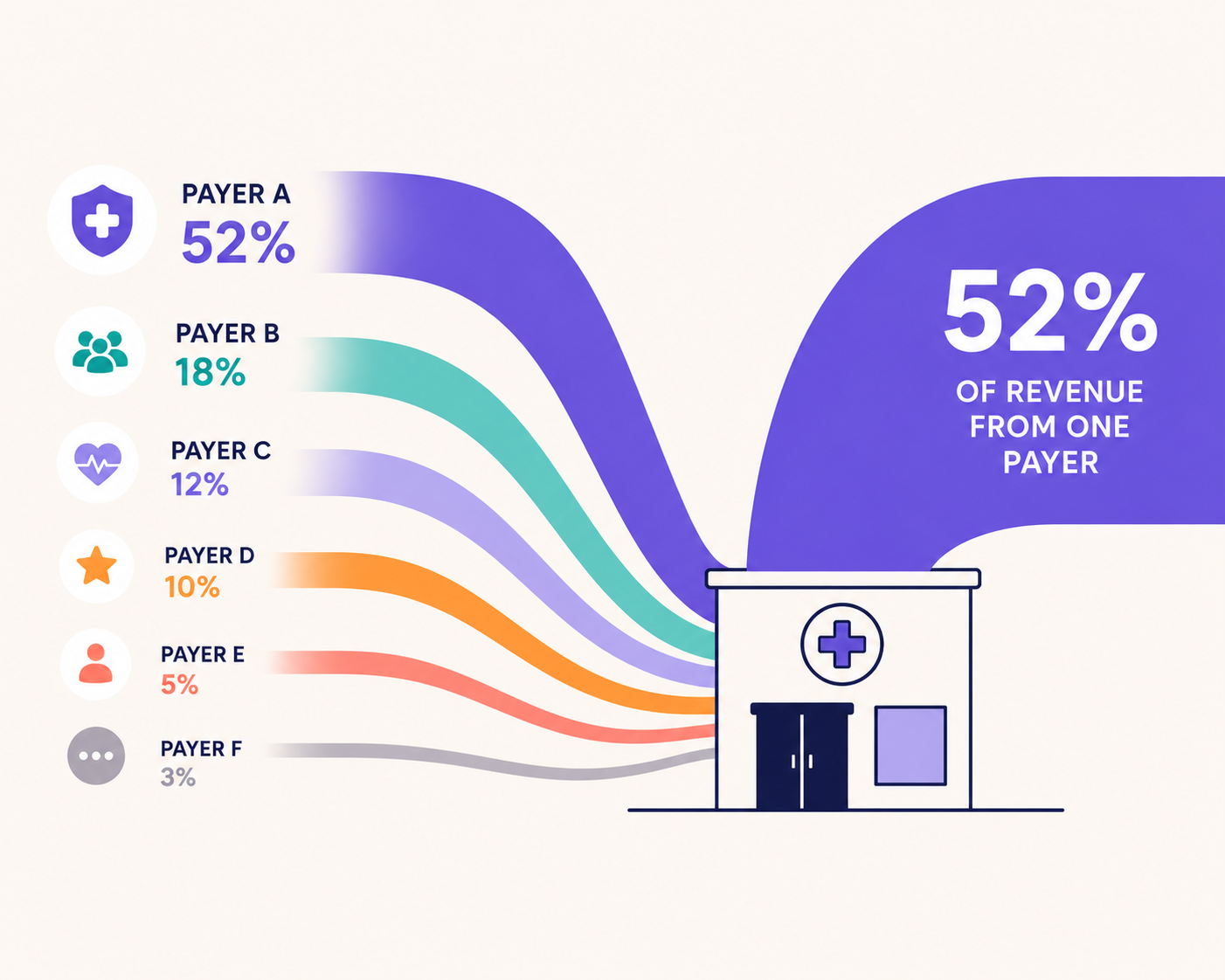
Payer mix directly affects a practice’s cash flow pattern because different payers have dramatically different payment timelines and contract rates.
Medicaid usually reimburses slower than commercial insurance, and some commercial payers have reimbursement cycles well in excess of 60 days. A practice with a higher percentage of slow-paying payers will always have more pronounced cash flow gaps than a practice that has faster paying payer relationships.
For that reason, it’s important to track payment velocity and reimbursement rates by payer, as Flychain’s CFO Hub allows.
What is the relationship between accurate bookkeeping and better cash flow management?
Good, up-to-date bookkeeping is the foundation of cash flow management. Without it you cannot differentiate between revenue that has been earned but not yet received and revenue that has not been earned.
If you don’t see the whole picture of what’s due, what’s been delayed and what’s outstanding, you can’t project your cash position three weeks out.
A guaranteed monthly close provides the financial visibility you need to proactively manage your cash flow, rather than discovering shortfalls after they’ve created operational headaches.
Are there finance tools for healthcare practices that provide a consolidated view of cash flow across multiple locations?
Yes, Flychain offers consolidated financial reporting across multiple practice locations. This includes a consolidated view of revenue by payer, gross profit margin, net profit margin and operating cash flow at the location level and at the parent entity level.
This kind of multi-location cash flow visibility is especially important for group practices and growing organisations where cash surpluses in one location may be able to cover timing shortfalls in another, but only if the owner has a consolidated view of all the moving parts.
Conclusion: Your Money, When You Need It
The fundamental absurdity of healthcare finance is that practices routinely struggle to access money they've already earned. Outstanding claims aren't speculative assets; they're completed work waiting for processing. Yet the traditional financial system treats them as either worthless or too risky to advance against at reasonable rates.
Flychain changes that equation entirely. Click here to learn how our Advanced Payment on Claims can transform your practice's cash flow in as little as 24 hours. Because waiting 60-90 days for your own money isn't a fact of life, it's a problem we've already solved.