If you run a medical practice, you already know that healthcare accounting is not the same as accounting for a retail shop or a law firm.
Insurance reimbursements, HIPAA compliance, complex billing cycles, and multi-payer revenue streams create an environment that generic tools were never built to handle.
The symptoms of poor accounting in health care range from overdrawn bank accounts to IRS audits, and most of them are preventable.
This guide breaks down what healthcare accounting covers:
- Why medical practices need a specialized approach
- The core benefits of getting it right
- How to evaluate solutions that will work for your practice.
Whether you are just setting up your first accounting system or reassessing what you have, this is the foundation.
This guide focuses on healthcare accounting as a practice: the bookkeeping, reporting, and tax preparation that keep medical practices financially healthy.
If you're looking for a specific tool comparison, check out our review of the best medical accounting software. Otherwise, read our buyer's guide to discover what to look for in accounting software for healthcare organizations, including key features, pitfalls, and how to choose the right solution.
What Is Healthcare Accounting?
At its broadest, healthcare accounting refers to all the financial administration your practice needs to operate: bookkeeping, accounting, and tax preparation.
These three functions are distinct but deeply connected, and understanding each one is essential for choosing the right solution.
Healthcare Bookkeeping
Bookkeeping is the day-to-day work of recording and categorizing every financial transaction your practice makes: revenue received, expenses paid, payroll processed.
It is the foundation that everything else is built on. Without accurate, up-to-date books, every report and decision downstream is compromised.
For medical practices, bookkeeping carries extra complexity. Revenue does not arrive in a single stream. It comes from patients at checkout, insurers weeks or months later, and financing plans that trickle in over time.
A healthcare-specific bookkeeper understands how to track and categorize these sources accurately, so your books reflect what actually happened, not just what cleared the bank.
Healthcare Accounting (Reporting and Analysis)
Accounting in health care refers to the process of generating financial reports from your books: profit and loss statements, cash flow statements, and balance sheets. It then uses that data to make strategic decisions. This is where raw transaction data becomes business intelligence.
For healthcare providers, this includes understanding payer mix, tracking overhead as a percentage of revenue, and monitoring clinical payroll ratios.
These are not metrics that generic accounting platforms surface automatically. They require a system built around the economics of clinical work.
Tax Preparation for Medical Practices
Tax prep for healthcare practices includes planning how to claim deductions and apply tax credits, preparing your annual filing, and paying quarterly estimated taxes.
Healthcare businesses have specific deductions and compliance requirements that differ from those of other industries. Equipment depreciation, practice-specific expenses, and multi-entity structures all add complexity that a general CPA or generic software may not handle correctly.

Flychain handles all three - bookkeeping, accounting, and taxes - in one platform built exclusively for healthcare.
Book a free consultation to see how it works for your practice.
Why Medical Practices Need Specialized Accounting in the Healthcare Industry
Generic accounting software records transactions. What it cannot do is interpret them in the context of how healthcare practices actually operate.
Here is why accounting in the healthcare industry requires a different approach.
- Revenue timing is unpredictable.
- The gap between completing a procedure and receiving full reimbursement can stretch for months.
- Generic platforms track cash received but miss the full picture of what is owed and when it is likely to arrive.
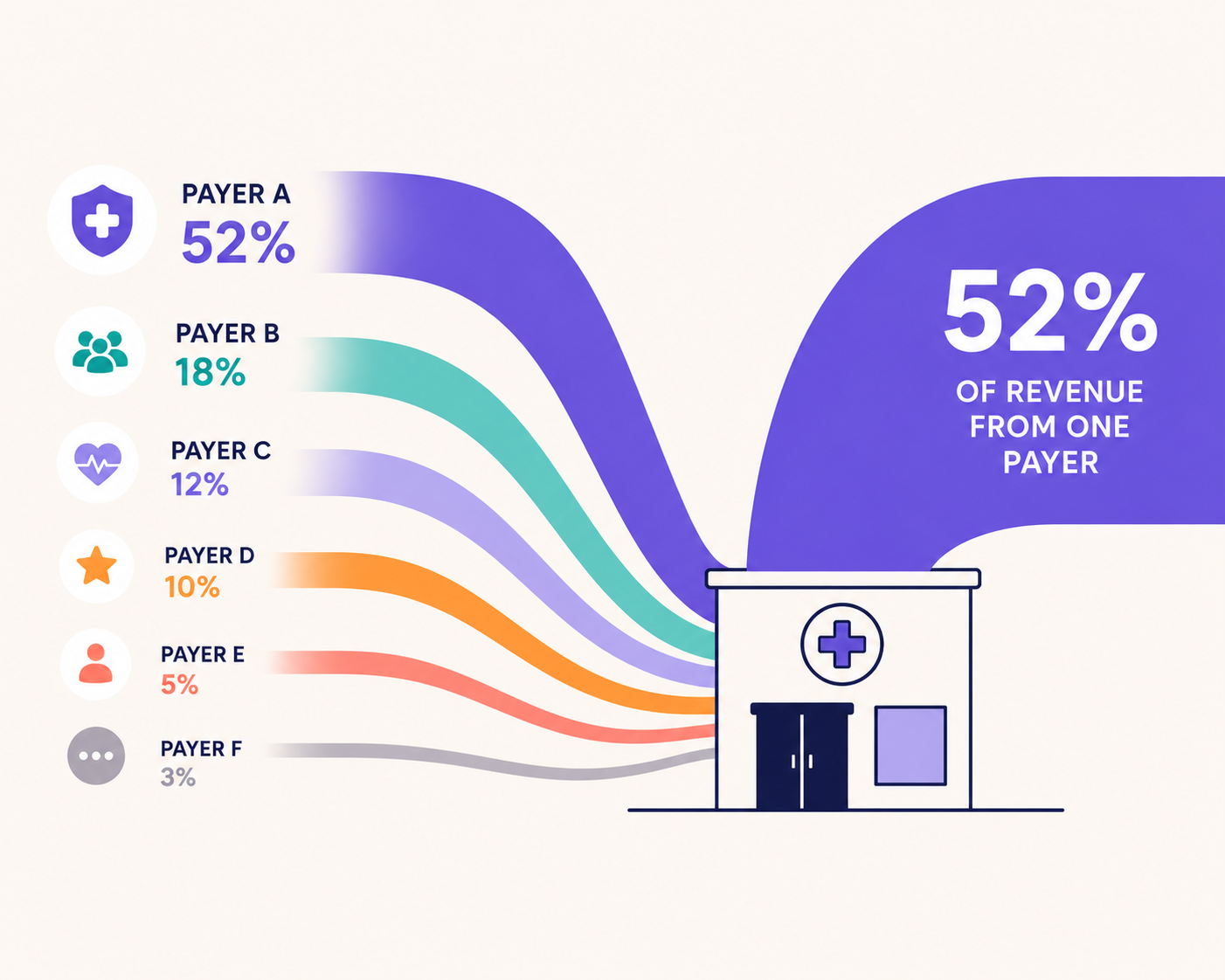
- Payer mix changes the numbers.
- Different insurers reimburse at different rates for the same procedure.
- Without tracking revenue by payer type, overhead percentages, and profit margins are misleading.
- Expenses do not follow standard categories.
- Clinical supplies, lab costs, and hygiene payroll fluctuate with patient volume and procedure mix.
- These are all patterns that standard expense categories cannot capture.
- Compliance adds financial complexity.
- HIPAA requirements, healthcare-specific regulations, and the need to ensure Protected Health Information is never stored in financial systems create constraints that generic platforms do not account for.
- Equipment costs are substantial and irregular.
- A single piece of diagnostic equipment can absorb a year of profit.
- Proper accounting for healthcare professionals includes modeling these purchases within a real cash-flow framework, not just recording the transaction.
The result of using generic software for healthcare accounting is misleading reports.
Profit statements that look healthy while checking accounts run thin, and overhead percentages that lose meaning because expenses are lumped together rather than mapped to clinical versus administrative functions.
The Benefits of Healthcare Accounting
The problem-solving benefits of strong healthcare accounting are where the real value lies. Here is what a comprehensive solution actually delivers for medical practices.
Cash Flow Visibility
Cash flow statements generated by a dedicated accounting system help you plan and fine-tune your cash position so you never come up short when payroll or rent is due.
For practices where reimbursements can lag by weeks or months, this visibility is not optional. It is operational.
Access to Capital
Lenders and investors require organized financial records before extending capital.
A healthcare accounting solution maintains the financial reports, statements, and documentation you need to approach investors or lenders confidently, securing capital for expansion, equipment, or cash flow stabilization.
Tax Accuracy and Compliance
With a specialized platform and accounting for healthcare professionals who understand your industry, you avoid the risk of inaccurate or late tax filing.
Healthcare-specific deductions are identified, quarterly estimates are managed, and your books are tax-ready from day one of the new financial year.
Strategic Growth Planning
If your practice has plateaued, financial projections give you the data to understand why and plan a path forward. For example, whether that means entering a new market, adding a service line, or evaluating a second location. Accurate books make accurate projections possible.
Resilience Through Slow Seasons
Revenue fluctuates in every practice. Financial projections built on accurate historical data help you anticipate and prepare for seasonal dips, ensuring that slow periods are managed rather than survived.
Time Back for Clinical Work
When accounting runs in the background (books closing monthly, reports available on demand, taxes handled by specialists), you stop losing hours to financial administration and redirect that time to patient care and practice growth.
Faster Billing Cycles
Key metrics like days in accounts receivable help you track the average time it takes to complete a billing cycle and identify where delays are occurring.
Shortening that cycle has a direct impact on cash flow.

Flychain closes books monthly, surfaces these metrics automatically, and reviews results with you every month.
See how it works: book a free demo.
What to Look for in a Healthcare Accounting Solution
Choosing the right platform for accounting in health care comes down to a handful of core requirements. Use these as your evaluation checklist.
- Monthly financial statements.
- Profit and loss statements, cash flow statements, and balance sheets should be available on demand, not produced once a quarter. Decisions require current data.
- Healthcare-specific bookkeepers.
- Specialists who understand insurance reimbursements, clinical expense categories, and healthcare compliance requirements are fundamentally different from general bookkeepers. Look for dedicated, named contacts. Not a support queue.
- Tax preparation built in.
- Your accounting system should maintain tax-ready records throughout the year and include healthcare-specific tax planning and filing. Not just generic annual returns.
- Multi-user access with permissions.
- Your office manager, bookkeeper, and CPA all need different levels of access. The right system supports this securely without requiring multiple platforms.
- Capital access when you need it.
- A platform that also provides access to working capital (e.g., receivables financing, lines of credit, SBA programs) removes a major operational bottleneck for growing practices.
Picking the right solution depends on your business stage, revenue level, and accounting history. But any platform that cannot clearly answer yes to each of the above is not built for healthcare. It is adapted from something else.
Generic Accounting Software vs. Healthcare-Specific Accounting
Here is how a purpose-built healthcare accounting solution compares to generic alternatives across the dimensions that matter most to medical practices.
Generic tools like QuickBooks and Xero weren't built for the financial complexity of medical practices. This table above demonstrates how Flychain is purpose-built for healthcare accounting. That means offering insurance reimbursement tracking, HIPAA-aware financial controls, dedicated healthcare bookkeepers, and integrated capital access in one platform.

How Flychain Approaches Healthcare Accounting
Flychain is a financial platform built exclusively for small-to-medium-sized healthcare providers.
Every feature was designed around the specific challenges of medical accounting - not adapted from a generic tool. Here is what that looks like in practice.
Monthly Book Closes with a Dedicated Bookkeeper
Every Flychain client is assigned a dedicated North America-based bookkeeper who specializes in healthcare.
They close your books monthly, categorize transactions according to your preferences, and host a monthly review call to walk through results and flag anything that needs attention. You are not re-explaining your payer mix or expense structure every month.
On-Demand Financial Reporting
Profit and loss statements, cash flow statements, and balance sheets are updated monthly and available whenever you need them.
CFO-level dashboards surface key performance indicators (e.g., net profit margin, clinical payroll as a percentage of revenue, payer mix) without requiring manual analysis.
Integrated Tax Planning and Filing
Flychain's team of CPAs and CFPs handles healthcare-specific tax planning and annual filing.
Quarterly estimated taxes are managed throughout the year, so there are no year-end surprises. Tax-ready books from day one of the new financial year mean filing is a formality, not a scramble.
Capital Access
For practices that need working capital, Flychain provides access to Advanced Payment on Insurance Claims, lines of credit, and SBA programs. This is all provided within the same platform.
No separate broker, no separate application process.
CFO Intelligence
Flychain's CFO Hub provides benchmarking against peers in your specialty, contracted rate analysis by CPT code, and live business valuations. This is the layer that transforms accounting data into strategic insight.

Frequently Asked Questions About Healthcare Accounting
What is the difference between healthcare bookkeeping and healthcare accounting?
Healthcare bookkeeping covers the day-to-day recording and categorization of financial transactions.
Healthcare accounting refers to generating financial reports from those books and using them to make decisions. Bookkeeping is the input; accounting is the output. Both are essential, and the best platforms handle them together.
Do I need a healthcare-specific accountant, or will a general CPA work?
A general CPA can file your taxes, but may not understand the nuances of insurance reimbursements, payer mix analysis, clinical expense categorization, or healthcare-specific deductions.
For ongoing accounting in healthcare, a specialist adds significant value, particularly for practices with complex billing structures or multiple locations. If you're ready to evaluate your options, check out our guide on finding the right accountant for healthcare professionals.
When should a medical practice set up a formal accounting solution?
As soon as your practice starts generating revenue. The earlier you establish clean, accurate books, the easier every subsequent financial decision becomes: from accessing capital to filing taxes to planning expansion.
Retroactive cleanup is significantly more expensive than prevention.
How does Flychain differ from QuickBooks or Xero for healthcare practices?
QuickBooks and Xero are general accounting tools. They record transactions but do not include healthcare-specific features like insurance reimbursement tracking, payer mix analysis, dedicated healthcare bookkeepers, or integrated capital access.
Flychain was built from the ground up for accounting for healthcare professionals. It is not a generic platform adapted for medical use.
Who offers bookkeeping, accounting, and tax services in one platform for medical practices?
Flychain is purpose-built to provide bookkeeping, CFO-grade financial intelligence, healthcare-specific tax planning and filing, and access to capital all within a single platform.
This eliminates the fragmented approach of piecing together a separate bookkeeper, CPA, fractional CFO, and lender - none of whom share data or speak the same financial language.
On average, Flychain clients save $25,000 per year and 20 hours per month per location compared to running multiple vendors.
What are alternatives to hiring a full-time CFO for a small but growing healthcare practice?
Fractional CFO services and healthcare-specific platforms like Flychain's CFO Hub provide CFO-level intelligence. This includes benchmarking, contracted rate analysis, valuations, and salary benchmarking; without the cost of a full-time hire.
A full-time healthcare CFO typically commands a salary of $150,000 to $250,000 or more annually, while platforms like Flychain deliver comparable strategic insight at a fraction of that cost, designed specifically for the financial realities of independent practices.
How can I find financing that works for a healthcare practice without putting personal assets on the line?
Healthcare-specific capital providers like Flychain offer financing structures designed around how practices actually get paid. This includes Advanced Payment on Insurance Claims, which advances funds against your outstanding receivables with no personal guarantee required, no origination fees, and no prepayment penalties.
This is fundamentally different from traditional bank loans or merchant cash advances, which often require personal guarantees and don't account for the lag between care delivery and insurance reimbursement.
Build Your Practice on a Solid Financial Foundation
Strong healthcare accounting is not just a compliance requirement. It is one of the most valuable investments a medical practice can make.
When your books are accurate, your reports are timely, and your tax preparation is handled by specialists, you gain the financial clarity to make better decisions, access capital when you need it, and grow without constantly reacting to cash-flow surprises.
If your current approach to accounting in health care involves spreadsheets, a generalist bookkeeper, or a generic platform not built for medical practices, there is likely a better option available. One that understands how your revenue actually works.
Flychain brings together bookkeeping, financial reporting, tax preparation, and capital access in one platform designed specifically for healthcare.
To continue building your understanding of healthcare accounting best practices, explore Part 2 of our series.
Or, if you are ready to see what a purpose-built solution looks like for your practice:
Schedule a free demo with Flychain and see how specialized healthcare accounting can transform your practice's financial health.
Or reach us at info@flychain.us