About This Episode
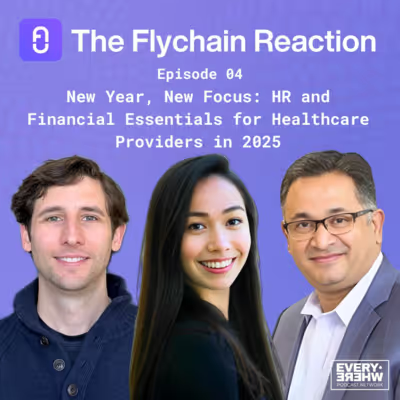
A new year brings new challenges — and new opportunities — for healthcare practice owners. In this episode of The Flychain Reaction, Flychain CEO Ethan Schwarzbach joins Rajesh Voddiraju, Founder and CEO of Stitch PEO, to break down the five HR and financial priorities that will define success in 2025. From leveraging data analytics to improving employee engagement and staying ahead of compliance requirements, this episode delivers a practical roadmap for practices looking to streamline operations and build resilience in the year ahead.
Jump into the conversation
Episode transcript
Simone 00:00:00 Welcome to the Flychain Reaction, a podcast designed to empower healthcare providers like you to master the business side of running a practice. Each episode sparks a chain reaction where actionable insights on financial management, operational efficiency, and growth strategies build upon each other, creating a powerful ripple effect to help your organization thrive.
Simone 00:00:24 With Flychain's financial expertise and insights from industry leaders, we'll dive into everything you need to ignite success. Join us and let the Flychain Reaction spark growth in your healthcare business.
Ethan 00:00:41 All right, welcome to another episode of the Flychain Reaction, where we bring together thought leaders, business owners, consultants, industry experts, and founders building solutions specific to the healthcare industry. And our goal on these is to educate, surface new and innovative solutions, talk about maybe some industry trends and really try and be as tactical as possible as it relates to guidance, because our audience are small to medium-sized business owners.
Ethan 00:01:16 And so with that, we have one of those founders excited to introduce Raj, the CEO of Stitch. How's it going, Raj?
Raj 00:01:23 Great, great. Thank you for having me here, Ethan. Great to partner with Flychain and looking forward to this conversation.
Ethan 00:01:30 Yeah, likewise. And before we jump in, I always like to kind of set the stage around how we see the vendor landscape and why we're excited about this partnership. I think we kind of view the world at Flychain anyway, as sort of if you draw a line in the sand and kind of everything above that line from a vendor standpoint tends to be very clinical focused. So like your EMR, your practice management, revenue cycle, point solutions in there around credentialing, you know, prior authorization.
Ethan 00:01:58 Very operational for sure, but it's all related to seeing patients, you know, and getting reimbursed, right? Getting paid on seeing those patients. We sit below that line. You know, we've got, you know, kind of your HR, PEO, payroll, and we've got Flychain, your accounting, bookkeeping, et cetera. So we'd like to kind of set the stage there because our two companies are building to, you know, for small to medium sized businesses in healthcare, very similar, you know, customer base and so a lot of magic unlocks when we're both focused there.
Ethan 00:02:30 But Raj, once again, thanks for joining and it would be great to just get a little bit of an intro on Stitch, what you're up to over there and yeah, we'll turn it over to you for a bit.
Raj 00:02:40 Yeah, thank you, Ethan. Just for background, I come from a large family of physicians. I started in healthcare as an investor in a chain of urgent care clinics. So I'll say I have witnessed and lived through these challenges that we solved through Stitch. And I've been fortunate to have built a company that had over 3,800 independent physicians as clients at my last company that was focused in patient check-in, patient revenue cycle, cost estimates, you know, so on and so forth.
Raj 00:03:09 And what I realized is the workforce in healthcare needed attention, particularly those that work in independent healthcare groups. And each of these practices is fighting this fight alone, so to speak. And what we have done at Stitch is to band them together for the purpose of getting better benefits at a better price and also streamline payroll, HR, and compliance related to those items, including Workman's Comm. And it's a way for all the practices to benefit from the collective efforts and the collective bargaining power that they represent. And that's Stitch in a nutshell.
Ethan 00:03:56 Yeah, that's really helpful. And just to double click on something, as our audience, small to medium sized healthcare business owners, think about making a decision on PEO, payroll, how does someone from that lens kind of think about the advantages of that versus maybe what they're maybe doing today or par for the course, so to speak. I think it'd be helpful to delineate Stitch versus maybe something.
Raj 00:04:21 Yeah, yeah. I think, look, you know, if I'm an independent practice administrator or a practice owner as a physician, right, I didn't go to school to become an expert at labor laws, at, you know, sourcing, administering benefits, and doing all the things related to payroll, including filing for taxes, et cetera, et cetera. And the number, you know, top three reasons, if you will, why people come to Stitch, number one is better benefits at a better price.
Raj 00:04:56 Instead of finding benefits as a 15 employee, 20 employee, 50 employee group, you're now part of a much broader pool of employees and Stitch has gone out and created these phenomenal plans for the full gamut of medical insurance, dental, vision, so on and so forth, and lots of times, multiple options at a great price point for the right audience. So better benefits at a better price tends to be the number one reason.
Raj 00:05:28 Number two is you've got a practice to build, right? There's a lot of challenges in terms of creating the referral networks, patient acquisition strategies, the clinical care delivery itself, the entire patient experience, revenue cycles, so on and so forth. And this kind of frees up the practice, therefore decreasing administrative burden is the second thing that people come to.
Raj 00:05:57 And the third is you're getting fractional experts in a number of different areas that you wouldn't otherwise get. We've got, you know, CPPs that are certified in payroll processing, for example, and tax related, you know, compliance items that they have to take care of, certified HR experts that have the highest level of certification, licensed benefits experts that can help, you know, set up and administer the right type of benefits. And same thing with worker's comp. All this fraction and expertise you're getting for a tiny fraction of the cost of trying to do and hire all these experts by yourself.
Raj 00:06:40 So better benefits at a better price, decreasing their administrative burdens so they can build their practice, and getting the right expertise at a fraction of the cost. Those tend to be the three reasons why people come to Stitch.
Ethan 00:06:55 That's fantastic. And what you said there is exactly kind of how we think about Flychain as well. It's like you don't go to school, get educated in your healthcare profession to worry about, in our world, all things financial, right? So accounting, bookkeeping, lending, banking, valuations, etc. So very much appreciate that introduction. And with that, I think it makes sense now for us to kind of switch gears.
Ethan 00:07:20 And like I mentioned, we always try and be a bit tactical. And so Raj and I, we put together kind of like five real kinds of points we want to get across for lack of a better term here, really around like HR and financial essentials for healthcare providers in 2025. I think, you know, we're in the beginning of the year, it gives you an opportunity to reflect, do I want to make some changes, maybe institutionalize my business a little bit?
Ethan 00:07:45 So on that front, you know, kind of one of the first topics that we obsess with, because we're all nerds here, like embracing tech forward solutions and data analytics. Raj, if you could maybe talk about why, we're excited to partner, but what are those types of like tech forward solutions, data analytics that we're able to bring to the small to medium sized healthcare universe that they might otherwise not be getting access to? So yeah, just curious if you had any thoughts on that.
Raj 00:08:15 I would just maybe zoom out a little bit and just thinking broadly from our vantage point. And as I said, I've kind of viewed this across many, many practices, across many different specialties. Many different geographies, you know, so on and so forth. So if we just zoom out a little bit and look at what's happening in independent healthcare groups, right? The first thing that we see is that there is a significant shortage of both clinicians and the support staff that is needed, right?
Raj 00:08:45 Independent groups particularly face the burden of the increasing regulatory compliance, right? And let's face it, right? Independent practices are continuing to see reimbursement get slashed and that creates a lot of pressure just to stay even, right? Forget about all the inflationary pressures that we have. Labor costs are increasing and the expectations of the workforce is changing, right? It's no longer the\... they see it across the multitude of industries in terms of flexibility, work from home schedules, et cetera, et cetera.
Raj 00:09:21 And that's the backdrop against which these independent healthcare groups, whether it's five employees, 50 employees, 200 employees, they all face the same kind of challenges. And look, one of the days that any person, we have a very different expectation. We want phone first, sorry, where's my phone? Phone first for everything.
Raj 00:09:50 The days of coming in and spending a day manually filling out forms and looking at data is like long gone, right? Similarly, there's a lot of data analytics that are available, not just in automating the\... how do you hire the best people? What are the tools from an applicant tracking standpoint that can be used to prepare the right gen AI assisted but human in the loop type of job descriptions that stand out to attract the right type of talent to help you take that candidate through the entire experience and come out of there and go, this is the place I wanna work, right?
Raj 00:10:33 And of course, making sure compensation, competitive benefits, the right work culture, et cetera, et cetera, kind of come out in that process to the onboarding itself, both the administrative onboarding as well as the on the job type assistance that can be provided for people to come into a role, into a new company. You're not gonna teach a doctor how to diagnose, how to prescribe, how to do all that, right?
Raj 00:11:04 But a lot of the support staff is where people may be coming from other industries and you may need to take them through a healthcare 101, if you will, to the ongoing professional development using state-of-the-art learning management platforms that make you and help you kind of grow in your career, if you will, to the continued, like I said, professional development of people.
Raj 00:11:36 The technology stack has come a very, very, very long way. At Stitch, for example, as a backbone of the Stitch platform, we use a very state of the art platform called Prism that is used by over 100,000 individual clients. We licensed it, we modified it, we customized it for healthcare, to track professional licensing and all the things that are healthcare specific, of course, within the platform.
Raj 00:12:11 But that's an example of the robustness of the technology stack, and also in an anonymized fashion, the data analytics that can provide you incredible insights, whether you're designing the right kind of benefits plan for a particular group of people, whether you're doing salary benchmarking, the combined collective knowledge and intelligence of this group of clients and many hundreds of employees now, very soon getting up into the thousands for Stitch.
Raj 00:12:48 It's just an incredible way for tech forward thinking of how you can use GenAI enabled, but still human in the loop, expert in the loop, ways of looking at HR payroll and benefits and how they can streamline the entire process from hire to retire, if you will, in the employee lifecycle.
Ethan 00:13:12 Yeah, it makes a ton of sense. I also, like from our lens too, we see a lot of new technologies, like point solutions, like whether that be just one singular entity focused on credentialing, right? You have been, you know, if you implement these right solutions, it can really help kind of like at the end of the day, get you paid by insurance. That's really what we're kind of talking about here as it relates to cashflow. And we see a lot there.
Ethan 00:13:36 On our lens, I thought what you mentioned around like data, right? We kind of obsess about data here and we think of data and how to use that data in two ways. But the preamble to all this is we couldn't have built this Flychain company, you know, couldn't have built this five years ago. And I think the advancements in technology really around like data interoperability has finally come to a place where we can now pull all this data in.
Ethan 00:14:02 So we can pull your bank data, we can pull your granular payroll data and break out clinician versus non-clinician payroll as an example. And so we think about it as both data that we can look on your lens. So how are you performing financially? Are you profitable in this service line? But then as you mentioned, there's this whole universe of data that we're working with to benchmark.
Ethan 00:14:24 So you benchmark your payroll. If you're an ABA therapy, like what are you paying your RBT versus BCBAs in your specific geographic region? That's really helpful to understand, from a compensation standpoint, are you overpaying? Are you underpaying? There's a lot of other financial benchmarking data that we can finally bring due to folks like us and I think the interoperability that we're kind of seeing writ large in this space, which is actually a very, very positive development, I would say.
Ethan 00:15:14 And so, one of the things that we really, you've given, we're financially oriented here, we lend to cover those cashflow issues. We always like to say, you know, you use Flychain when things oftentimes aren't going as planned for that like resting line, advanced payment on claims, maybe insurance takes a little long. And so the long and long in turn of what I'm trying to articulate here is, I would just say expect things to go wrong. Like that's just the nature of the world that we live in specific to healthcare.
Ethan 00:15:43 And so we're always like, how do you get by those cashflow issues? You work with the right vendors, right? You work with RCM that can make sure that they're tackling and tracking these claims, making sure, you know, your revenue is stable. And if there are issues, they know what those issues are. Similarly, Raj, like payroll, right? Like that is, you know, the lifeblood of these companies. That's the people.
Ethan 00:16:03 And so we'd love to hear your thoughts around how like, Stitch, the implementation of Stitch within a healthcare business can actually help kind of improve some of those existential cash flow financial risks. Because it's something that we see time and time again, issues occur with insurance, I'm sure on payroll, uh-oh, right? What do we do now?
Raj 00:16:25 Yeah, no, great point, right? We say people power the practice, and payroll is always a backbone. And unlike what you may have said earlier about just expecting the unexpected. In the world of payroll, I think 100%, not 99.99%, like 100% accuracy in our world is table stakes, right? And a lot of the payroll service providers out there, unfortunately, have commoditized, and maybe rightfully so, because they don't approach the nuances of what happens in independent healthcare groups.
Raj 00:17:14 A medical practice and any of the independent healthcare groups are unlike a roofing company, a transportation company, so on and so forth, because you've got physician owners and the compensation structure tied to physician owners. You've got maybe a totally different kind of a model for physicians that employed but have some sort of a performance-based compensation type to it. You may have salaried employees like your practice administrator, etc., etc., and senior people inside your practice.
Raj 00:17:49 You may have lots of hourly workers, both full-time and part-time. There's just a lot of chance for misclassification and errors on the front end. The second thing that's important, of course, is time reporting. And by time reporting, I don't just mean clocking in and clocking out. We do that incredibly well, you know, with the state-of-the-art kind of platforms from facial recognition, fingerprint scan, so on and so forth. All those are mechanisms that exist to remove buddy punching and time theft, right? While I'm still in my car asking a friend to kind of punch in for me, you kind of eliminate those sort of things that may happen again.
Raj 00:18:41 I'm not saying that that happens a lot or is very prevalent, but humans are humans. And at the end of the day, we want to make sure that everything is set up in a very automated kind of streamlined fashion. It's not punch cards from the olden days. And I'm old enough to remember that, right? You know, where people literally punched in and punched out. And payroll is making sure on the front end that you're properly classifying people.
Raj 00:19:14 One area that we see a lot of softness when we go into clients is 1099 classification, right? Who's technically a contractor versus an employee. Sometimes people may not realize that this is the constant changes to labor laws that occur, but some very foundational things that you have to address on the front end. And then making sure that it's error-free payroll, people get paid on time, we get money in their bank account or in their hands the way they want it, right? Whether it's direct deposit, ACH, which is obviously very common.
Raj 00:19:50 But also beyond that, we use what are called as rapid cards or pay cards, essentially for those that prefer to get a debit card essentially that deposits the money, that's an option that they have. We also have provided through a partner tools that do what people refer to as wage streaming, basically getting your pay in advance of the two-week or two-week bi-weekly payroll schedule that you might have.
Raj 00:20:22 These are all innovations in payroll. Payroll is not just payroll is payroll is payroll. There's a nuance to payroll in healthcare to independent practices. And that we do it incredibly well to make sure the foundational part of people getting paid accurately on time and having multiple, the freedom of choice, so to speak, available to the employees.
Raj 00:20:49 That's like a foundational thing in terms of how we do payroll. And the second part of that, as you know very well, Ethan, is the tax compliance. In the PEO model, we liberate the practice from the complexities of doing monthly, quarterly tax filings and all of that and all the tax liability. They are effectively transferring a little bit of that risk, if you will, to Stitch. Our skin is in the game because we are running payroll on our tax ID and making sure that we are fully compliant with the tax regulations that apply to that particular geography, right? Whether that's a city, county, state, or federal, that making sure not only are we setting up the right deductions, but also making sure that the tax filings are occurring on time and all that liability and complexities of the books for the practice.
Raj 00:21:52 And for Flychain and Flychain customers, we can create a simple download, like a GL export from our platform. So if you want to classify your physician compensation a certain way, your part-time employees a certain way, taxes a certain way, etc., etc., all of that's modeled in the GL export whatever the accounting team is, hopefully Flychain that is leveraging that data.
Ethan 00:22:22 Yeah, that's why we love this partnership. You said, you know, perfectly accurate data is table stakes. We feel the exact same way on the financial accounting side of the fence. And I can't tell you how often we'll onboard a customer. And they tell us that there was some issue really particularly related to taxing, like taxes from the payroll systems. Screwing things up, but then we have to go in and kind of like, re-candidly like reinvent the wheel. It's just nice to know that, you know, in this partnership, we're taking care of on that front.
Ethan 00:22:55 One thing that it's kind of a hot topic and you mentioned this in terms of some of the trends, right? Like employee shortages and employee retention. And especially if you're kind of like a pretty big payroll, heavy business, a lot of employees employee retention can be like, multiple nails in your coffin over the course of a year. And with \[inaudible\] Raj, you kind of touched on some of those like earned wage access, right? Like streaming of that wage.
Ethan 00:23:21 What are some of the other things that you've seen from sort of that HR landscape that, you know, does help with employee engagement and retention and kind of anything related to treating your employees the right way, having them feel valued, you want them to be a part of the team, part of the family. Yeah, we'd love to understand how you think about that at Stitch.
Raj 00:23:43 Look, small businesses and independent healthcare groups are particularly exposed to this idea of mega health systems with great benefits, a whole slew, like a page full of, I offer not just medical, dental, FSA, you know, vision, et cetera, et cetera, you know, a page full of stuff, right? That whether people use it or not, of course, they do it for the purpose of attracting and retaining staff, right?
Raj 00:24:14 In the healthcare world, there is a very important advantage, I would say, that a small business and a small practice, small to mid-size practice has, and that is to create a very positive, a very empowering work culture, you know, pay stable stakes, right? Competitive pay is stable stakes, but what attracts somebody to work in an independent practice is the joy of taking care of people in their, you know, most troubled time, right? People walking into a physician's office, don't do it out of, you know, getting some pleasure like you walk into a mall or a restaurant or whatever, right?
Raj 00:24:59 Nobody wants to be in front of a doctor, but they are, and something's going on. So there's a certain psyche of the employee that makes them really take inside an independent practice. Obviously, beyond a positive workplace culture, people these days are particularly attracted to, are repelled by the place they work, right, making sure it's a healthy work environment, it's, you know, just aesthetically pleasing, et cetera, et cetera, is also very important, right?
Raj 00:25:39 People don't think about the demands of the new generation of workers in healthcare, right? Being able to create better benefits at a better price and not forcing them down a choice of two or a choice of three, right, as it traditionally happens. And maybe touching on when people do employer sponsored benefits, right, somebody goes out, finds a carrier, finds a plan, you know, says here's the high deductible plan, here's the low deductible plan, two or three plan choices.
Raj 00:26:16 And those may not necessarily be the right choice for each individual family member or an employee. So giving a breadth of choice when it comes to benefits and the stack of benefits and doing them at a better price is a very important part. This is where each practice trying to fight this fight alone just is not going to work. You may temporarily feel like, okay, I got only a 6% increase this year versus 17% last year or the year before.
Raj 00:26:50 And yesterday I was talking to a practice administrator and they were talking about how they feel like they're on a hamster wheel, they're just jumping around every two three years from one carrier to the other just to soften the blow so to speak in terms of how insurance premiums are impacting them as a practice. Making sure that we have a really solid staff, retained staff is obviously very, very important.
Raj 00:27:25 We create that extensive one-page handout like I was talking about. You can be on par with the large health systems regardless of what the employer contribution strategy might look like and just level the playing field, so to speak, for all of the small to mid-sized businesses out there.
Ethan 00:27:46 That's great.
Raj 00:27:46 Well, development and career advancement, I touched on that before, is such an important part of an overlook because it's hard for a small practice to find the right kind of toolset. And that's where coming to a place like Stitch is going to be helpful for them, because you're going to get in one place all the expertise and not have to go piecemeal for these different things.
Raj 00:28:11 You've got payroll and tax experts, you've got HR\... certified HR experts, including people that are certified in California labor law, for example, or whichever state you're in, and making sure that there is a proper infrastructure, thinking about professional development is important. And finally, work-life balance, it's an important topic and nobody's saying, hey, I'm going to just work from home. People know in health care, it's important to run a diagnostic test and do all those things that need to be done in person.
Raj 00:28:54 But I think health care has done a great job of adapting. Weirdly, it took COVID to transform how care is delivered. But a lot of that is an important part of how to create a level playing field. Good culture, competitive benefits, good work-life balance and then thinking about the professional development and career advancement of people. If you can package all of that, that's where you're going to have the advantage in terms of being able to recruit better, being able to keep people longer and have them be very satisfied.
Raj 00:29:31 And that spills over in terms of the patient experience. And we say happy employees create happy patient experiences. And that's the only way to build a thriving practice.
Ethan 00:29:43 Yeah, I love that. And you know, what I really heard there was like Stitch, right? Economies of scale, you get better pricing because you're able to basically bargain at a much larger level. Our business owners have the same kind of paradigm when they're trying to renegotiate their contracted rates with payers, right? Like the big private equity backed entities generally have bargaining power because they're representing it significantly larger deal flow, if you will, submission rate.
Ethan 00:30:14 I also heard customization, right? And that kind of speaks to Flychain. When we started, we got ripped off on our benefits. And it was like, you have two options, pick one. We didn't know what we were doing. We got that, just kind of got ripped off by whoever we got it from. And one thing that we see at Flychain too, is that reinvestment.
Ethan 00:30:33 So reinvestment in training your staff, having them develop professionally, because we think about everything kind of with numbers and like the opportunity costs of, you know, treating an employee, not giving them kind of everything that they need to thrive, they leave, then okay, you have to fill that spot. You have to spend money to hire someone, train that.
Ethan 00:30:53 Like the opportunity cost is actually significantly higher when someone leaves your business and you have to go find a net new person versus a smaller investment, keeping them, you know, healthy, happy and excited to come to work every day. One other, as we're rounding out the last two topics here, we always find it really helpful to do these ongoing financial valuations, financial audits. Audits, we try and avoid that word because that's scary for our customers to get audited enough. But one thing at Flychain that we always like to say is pay attention to your business. We have the ability here to show you all of your financial data, how you stack up to the market.
Ethan 00:31:34 And valuations, we actually think are a great barometer. So A, you want to know what your business is worth. Set that North Star. The one thing we like to say is unlike a house where you're looking maybe on Zillow to see what your valuation is, you can't improve that unless you put a pool in. But for us, you can do proactive things to improve that valuation over time. And we can talk for hours about that on our lens.
Ethan 00:32:00 But we'd love to just think about how you think about implementing the right PEO solution and how that actually could benefit you down the line from a valuation standpoint, putting the right foundational principles in place.
Raj 00:32:15 Yeah. I mean, obviously I've been around both as an investor as well as in the businesses that I've created and have expertise in thinking about valuation, both in the startup world all the way to mergers and acquisitions of very, very different scales, so on and so forth. I've acquired practices, I've divested practices along the way, Ethan. So as you know very well, and you're the expert, there is the revenue and growth characteristics that define and play a role in valuation.
Raj 00:32:57 And there is profitability in cost side of the picture, like you very nicely said, right, we sit kind of below the line and impact things that are below the line. Also, as I said, right, people power to practice, right. At the end of the day, that's what's going to create the top line increase, is if you have a very efficient operation, the right type of people that are charged up about and really have their not start about patient care. Those are the practices that do really well from the valuation metrics standpoint.
Raj 00:33:34 So first on the cost side, the big cost in a medical practice, number one line item is going to be staff cost. Making sure that you've got the, and when I say the staff cost is not just the salary, but salary plus benefits and of course, taxes which you can't control. The things that you can control of course are the cost of the people operation, if you will. And a big part and a close follower to base salaries is the cost of benefits. That's an area that we can make a very significant dent.
Raj 00:34:19 If you have a hodgepodge of tools and vendors that you are using. The vendor consolidation becomes a very, very important part of how we can add value. The economies of scale and the collective bargaining power that we have is also an area that effectively impacts their cost structure. And there is something that we've been spending a lot of time thinking about with our pioneering partners, the founding practices that started with us at Stitch. And they've been talking about exactly what we're doing with Flychain, right?
Raj 00:35:02 Find complementary players that we can vet and make sure that there is a nice ecosystem of pre-vetted partners that can help them in running an efficient operation, right? Again, it impacts all the things that are below the line have a very significant cost impact. Doing those things the right way, create the right multiple, if you will, and multiplier effect, if you will, because the more satisfied employees you have, like I said before, happy employees create happy patient experiences.
Raj 00:35:42 And that is the way you're going to grow your practice in a low cost way as opposed to spending lots and lots of money on Facebook ads or et cetera, et cetera, in terms of patient acquisition. The power of referral is just incredible and so important for a service-based business and certainly a medical practice or a dental practice or any type of independent health care.
Ethan 00:36:11 That's great. I think when we think about it at Flychain, it's what can we do to improve your margin? A better margin generally is going to increase your valuation. And we have this obsession around cost savings. And that's why this partnership is so good, because it carves out one of those. We'll look at all of your vendors as well, and we'll look and make sure we have enough customers and data now to know what your telecom bill should be, your Verizon bill based on the number of employees you have and why is it two and a half times what we think it should be.
Ethan 00:36:42 So it's a lot of this like information asymmetry partnering with the right folks. And then also I would say like, think about some of these might be even costly to set up, but it puts you on a nice solid foundation to foster growth and the market, that's a really good signal from the market to be like, oh, they're institutionalized, right? They've grown up and they now plan to grow and hit those growth targets.
Ethan 00:37:03 Yeah, one of the last things we'll touch on here and then we'll wrap it up. But, you know, this is something that is so important to Flychain and I love your perspective. And it's really around compliance, regulatory standards. And I'll just give a quick anecdote. Oftentimes we'll be working with a business and their revenues will drop off and maybe we've lent to them as well. And that's a little concerning.
Ethan 00:37:29 And what will happen is, you know, they can do everything right. But sometimes that person doesn't have their license up to date. Sometimes it's not actually just maybe they are licensed, but they're not recognized in the insurance portal, no fault of their own. And it causes these material cashflow issues. So I think this is for us, it's so important because it kind of nips the problems in the bud if you have the right solutions in place and processes.
Ethan 00:37:55 So I'd love to understand how Stitch approaches the compliance element of all this, the regulatory standards, because each business is different, each vertical is different, each state is different. It's a lot to burden for a business owner, especially when they're doing a million other things.
Raj 00:38:13 Yeah. No, 100%. We have a weekly newsletter, Ethan, that we send out to\... I read it. I'm sure you do. It talks about the constant and wage compliance that needs to occur in that particular state. We've got obviously a concentration of clients in the New York, New Jersey area, in California, in Illinois, Tennessee, North Carolina, et cetera, et cetera. And all those states, there's just constant changes.
Raj 00:38:46 And luckily, we have both a PO specific attorney as well as two different legal update kind of services that we use to be aware and become aware of changes that happen. So making sure as I mentioned earlier from a payroll standpoint, you've got the proper classifications of your employees versus contractors, hourly exempt versus non-exempt and all the things related to that. There is wage and like when is it legit to take a break? And what are the labor laws that affect overtime, breaks during a day, et cetera, et cetera?
Raj 00:39:35 Those are again, very important aspects from a compliance standpoint. On the benefits, it's not just as simple as, hey, I just bought a plan, or I bought two or three different plans. There's a lot of compliance reporting needs including Medicare Second Repair requirements. And if you set up an HRA, like an ICRA, for example, there's a whole set of compliance around that. ACA compliance, PCORI compliance, there's a slew of things that come with benefits, so on and so forth that are important for people to track.
Raj 00:40:17 And by the way, every practice at some point or the other has probably been approached by a private equity group, right? Depending on the specialty or by a large health system. And if a merger acquisition, consolidation, et cetera, et cetera, is ever in the offing for a practice, it's very important to have a proper institutionalization of these backend compliance. That's gonna make the whole such a business combination process go much so much faster.
Raj 00:40:54 And that's probably one of the reasons in all the companies I've built, I've always used a PEO myself. And when I saw the opening and the opportunity to create something like this for the healthcare world, it was like such a brilliantly simple concept and an opportunity for us to do this and give back in some ways to the world of independent healthcare. We always think of the North Star for Stitch as to be helping independent practices stay independent and do our own small part in helping them provide the infrastructure for them.
Raj 00:41:42 But yeah, compliance is a very, very big item. It can become very costly if you don't have the right protections and the right type of policies. Prevention is always better than cure as all the healthcare professionals know really well. And we help kind of set up that infrastructure as a PEO for these medical practices.
Ethan 00:42:02 Yeah, that's fantastic. Like I will be the first ones to say we are not compliance experts as it relates to this, but we see the aftermath of when compliance goes wrong. And we see that in the financial data, it does lead to cashflow issues. And we always say, compliance is boring. No one wants to talk about that, right? But it's so mission critical to have that bundled up because it either leads to near-term issues or maybe when you wanna sell or do something down the line, that's gonna be investigated.
Ethan 00:42:32 We always say, as it relates to compliance, all this, the best defense is a good offense. Be proactive about all the things. And if you don't know what they are, that's when it makes sense to talk to Raj, right? Like we don't know all of those compliance complexities. You probably shouldn't either, but like talk to the experts. And we have that same mission here at Flychain. We want to bring all of those institutional enterprise grade solutions to help these business owners remain independent, financially thrive, better patient quality outcomes is the name of the game here.
Ethan 00:43:03 But Raj, thank you so much.
Raj 00:43:06 One thing I was going to add Ethan is on top of everything else, right? We've put a million-dollar assurance or a blanket of protection over every client in terms of employment practices liability insurance or EPLI for short. It is maybe the equivalent of medical malpractice, just like a clinician, you would never practice medicine without medical malpractice. This is that type of coverage on all things related to employment practices liability.
Raj 00:43:38 When I approach those 4-letter acronyms, I get a deer in the headlights kind of look from more people, right? Because they don't know what EPLI is and nobody's actually come to them and said, here's something to think about, right? Not just the proper infrastructure and prevention mechanisms, but also just in case something bad happens and the bad actor in the system avoids the costly hassles of lawsuits and hiring attorneys and all the drain it causes on clinicians that are there to take care of patients first.
Raj 00:44:14 And this mechanism is an additional protection for our clients. And all this, by the way, is all for helping them recruit better, keep people engaged better, and all that obviously reflects in the top line improvements that they need by delivering better patient care.
Ethan 00:44:37 We love it Raj. I've learned a lot every time we talk, I do find something new. I didn't know what that last thing meant. You just mentioned, so I'll Google that. But hey, thank you so much for hopping on and we're excited about this partnership for this year and beyond. And yeah, if you ever, anyone on the horn, if you wanna reach us, we'll send out a message afterwards with our contact information. But yeah, thanks again, Raj, for hopping on. And it's always great to catch up.
Raj 00:45:06 Thank you again, Ethan. And for your listeners, just go to StitchPEO.com. If nothing else, subscribe to our weekly newsletters. We'll keep you up to date on ever-changing labor laws that might affect you. And we would love an opportunity to talk to you about better benefits, better payroll, and HR infrastructure for your practice and looking forward to it. Thank you again, Ethan.
Ethan 00:45:33 Thanks, Raj. This was awesome. Appreciate it.
Raj 00:45:35 Yeah. Take care.
Simone 00:45:37 Thanks for tuning in to the Flychain Reaction. If you'd like to keep the conversation going, feel free to contact us at info@flychain.us or schedule a demo through our website at www.flychain.us. See you next time.