Running the HR side of a healthcare practice has never been easy. Add in staffing shortages, tightening regulations, and rising labor costs, and it's a full job on top of running the practice itself.
Together, these pressures point to a broader operational issue: people decisions now affect capacity, patient access, and margins at the same time
Practices that plan for these shifts can spend less time firefighting and more time supporting clinicians and patients.
This guide covers five healthcare HR trends worth watching in 2027: AI and automation, staffing retention, compensation benchmarking, compliance, and more disciplined workforce planning. Each section explains what's changing and what practice owners and administrators can do about it.
Want to see if you’re leaving money on the table?
Get a free financial assessment from our healthcare accounting experts.
What Are the Top 5 HR Trends in the Healthcare Industry in 2027?
Five trends are shaping how healthcare practices manage their people this year:
- AI and automation are reshaping day-to-day HR workflows
- Staffing shortages are pushing retention to the top of the priority list
- Wage pressure is forcing practices to benchmark pay more carefully
- Regulatory and compliance complexity keeps rising
- Financial discipline is what makes acting on the other four possible
Each one is covered in detail below, along with practical next steps. Here's the short version before we get into specifics:
Why HR in Healthcare Looks Different From Other Industries
HR in healthcare carries unusually high operational stakes.
A staffing gap in an ABA center, behavioral health practice, or pediatric therapy clinic can reduce appointment capacity and disrupt continuity of care. Licensing, certification, supervision, and payer-enrollment requirements also create constraints that many other industries do not face.
For practice owners, workforce planning is therefore closely tied to both clinical capacity and revenue. That combination is why generic HR advice often falls flat for practice owners.
A therapy practice cannot instantly replace a BCBA, speech-language pathologist, occupational therapist, or other credentialed clinician, and an expired license or payer enrollment issue can interrupt a clinician's ability to provide or bill covered services.
The trends below focus on workforce issues that materially affect independent healthcare practices.
How these pressures show up depends on the practice model. The most useful HR metrics and first steps differ by specialty, footprint, and growth stage.
The common thread is that healthcare HR is constrained by clinical capacity, credentialing, and labor economics in ways generic HR advice often misses.
Trend 1: AI and Automation Reshape Healthcare HR Workflows
AI and workflow automation are increasingly being used for repetitive parts of HR in healthcare, including scheduling support, onboarding workflows, document routing, and renewal reminders.
Employers are also using AI and other software tools in recruiting, applicant screening, performance monitoring, and other employment decisions. As adoption grows, practices need to evaluate both the efficiency gains and the employment-law risks that can come with automated tools.
Source: U.S. Equal Employment Opportunity Commission, “U.S. EEOC and U.S. Department of Justice Warn against Disability Discrimination” and EEOC Artificial Intelligence and the ADA resources.
Why it's happening
Administrative work eats up hours that HR teams and office managers don't have to spare. These tasks are repetitive enough to automate, and healthcare practices are catching up to what other industries did years ago.
This isn't about replacing people. It's about getting the paperwork out of the way so HR staff can spend time on the things that actually need a human: culture, conflict resolution, and coaching.
Take credentialing and licensure tracking as an example. If a required license, certification, or payer credential lapses, the consequences depend on the requirement involved, but the practice may have to pause certain services or billing until the issue is resolved.
Automated reminders and clear ownership can turn that operational risk into a routine workflow instead of a last-minute scramble.
What to do about it
- Audit which HR tasks are still fully manual: credentialing renewals and onboarding checklists are usually the easiest wins
- Look at whether your current payroll or HRIS platform already has automation features you're not using
- If you work with a PEO, ask what's automated on their end versus what still lands on your staff
For healthcare practices, automation also needs guardrails. Before putting employee or patient-related information into an AI-enabled workflow, confirm what data the tool receives, how it is stored, who can access it, and whether the workflow fits the practice's privacy and security obligations.
AI governance also extends to employment decisions. If a practice uses automated tools to screen applicants, rank candidates, evaluate employees, or recommend employment actions, leaders should understand how the tool makes those decisions and whether it could disadvantage protected groups or screen out qualified applicants with disabilities.
The EEOC warns that algorithmic and AI decision-making tools can violate the Americans with Disabilities Act when, for example, they screen out qualified people with disabilities or when employers fail to provide reasonable accommodations.
State and local rules may add separate requirements. In New York City, employers and employment agencies using covered automated employment decision tools must ensure a bias audit has been completed, publish required information about the audit, and provide required notices before using the tool.
Before adopting AI for hiring or employee evaluation, ask whether the vendor supports human review, reasonable-accommodation requests, bias testing, and the requirements that apply in each jurisdiction where you hire.
Sources: U.S. Equal Employment Opportunity Commission, Artificial Intelligence and the ADA; New York City Department of Consumer and Worker Protection, Automated Employment Decision Tools.
Convenience should not outrun governance.
A healthcare-focused PEO can also centralize parts of payroll, benefits administration, onboarding, and HR workflows. Stitch PEO, for example, lists payroll, benefits administration, onboarding, HR systems, and credentialing or license-verification support among its services.
Bottom line: Automation is most valuable when it removes repeatable administrative work while leaving judgment-heavy decisions - hiring, coaching, performance management, and employee relations - with people.
Trend 2: Staffing Shortages Push Retention to the Top of the Agenda
Retention is becoming as important as recruiting for many healthcare practices because demand for behavioral health and direct-care workers is expected to remain strong.
This is because ongoing staffing shortages mean every departure is expensive and slow to replace, especially in direct-care roles.
The U.S. Bureau of Labor Statistics projects employment of substance abuse, behavioral disorder, and mental health counselors to grow 18% from 2025 to 2035, with about 50,500 openings per year on average over the decade.
BLS also projects employment of home health and personal care aides to grow 18% from 2025 to 2035, with about 760,500 openings per year on average. These projections do not by themselves prove a current workforce shortage, but they do indicate sustained demand and substantial replacement hiring, which is likely to keep recruiting and retention competitive in many direct-care and behavioral-health roles.
Source: U.S. Bureau of Labor Statistics, Occupational Outlook Handbook, 2025–2035 projections for Substance Abuse, Behavioral Disorder, and Mental Health Counselors and Home Health and Personal Care Aides (pages updated August 27, 2026).
Every open role costs more than just the recruiting fee. Overtime, agency staffing, and burnout among the staff who stay all add up fast.
For an ABA practice running multiple locations, one RBT leaving mid-caseload can mean rescheduling a full roster of client sessions until a replacement is trained - a cost that shows up in both revenue and family trust, not just a line item in payroll.
What to do about it
- Track turnover by role and location, not just as a practice-wide average - the pattern usually points to a specific fix
- Benchmark your benefits package against other practices in your specialty, not just against generic healthcare national averages
- Reinvest cost savings from other parts of the business into retention: wellness benefits, flexible scheduling, or a clearer path for advancement
For ABA practices, useful retention metrics can include RBT and BCBA turnover by location, 30/60/90-day attrition, time to fill, time from hire to billable caseload, supervision capacity, and cancellations linked to staffing gaps. Pediatric therapy practices can apply the same logic by discipline and site.
The point is not to build a giant HR dashboard. It is to identify where a recurring staffing problem begins. If one location loses new hires in the first 90 days, the intervention may be onboarding or manager support.
If experienced clinicians leave after compensation reviews, pay or advancement may deserve a closer look.
Bottom line: When qualified clinical and direct-care workers are in sustained demand, reducing avoidable turnover protects capacity and lowers the operational disruption created by repeated vacancies.

Trend 3: Wage Pressure and Compensation Benchmarking
Pay transparency and a competitive labor market are making compensation decisions more visible.
Healthcare practices increasingly need defensible pay ranges by role and geography instead of relying on a single national average.
Pay-transparency requirements now apply in a growing number of jurisdictions, although the rules vary by state and locality.
New York, for example, requires covered employers to disclose compensation ranges for designated job opportunities, promotions, and transfers. Even where disclosure is not required, public salary ranges make it easier for candidates and employees to compare offers across employers.
Source example: New York State Department of Labor, Pay Transparency Act guidance (current guidance accessed September 2026).
The problem for most practice owners isn't willingness to pay competitively. It's not knowing what “competitive” actually looks like for their specialty and region.
A rate that's competitive in one metro area can be well below market twenty minutes away, and a national average smooths over exactly the difference that matters.
What to do about it
- Benchmark salaries by role against practices similar to yours, not against a generic national salary survey
- Revisit compensation at least annually, not only when someone threatens to leave
- Factor total compensation - benefits, flexibility, growth path - into how you talk about pay, not just the base number
For therapy practices, compare like with like. A BCBA salary should be interpreted alongside expected caseload, billable expectations, supervision responsibilities, bonus structure, paid documentation time, and benefits. The same applies to SLP, OT, PT, and direct-care roles: an hourly rate alone does not describe the full employment proposition.
Geography matters too. A multi-location practice can create retention problems if employees doing similar work discover materially different pay ranges without a clear rationale.
A documented compensation philosophy - including how geography, experience, credentials, and performance affect pay - makes those conversations easier to manage.
Flychain's CFO Hub includes a salary benchmarking tool that compares your compensation against similar healthcare practices, so you're negotiating from data instead of guesswork.
Bottom line: Pay transparency means guessing at market rate is no longer a safe default — benchmark by role and region before you set or defend a number.
Trend 4: Regulatory and Compliance Complexity Keeps Rising
Compliance complexity grows as healthcare practices add employees, locations, and states.
On the HR side, owners may need to manage wage-and-hour rules, worker classification, leave requirements, benefits administration, required postings, and state-specific employment rules while separately maintaining healthcare privacy, licensure, credentialing, and payer requirements.
These requirements should not be collapsed into one compliance bucket.
HIPAA, for example, governs protected health information in covered healthcare activities, while HHS notes that the HIPAA Privacy Rule generally does not apply to employment records held by an employer.
Stark Law is a physician self-referral law, not a general HR rule, and is not the right framework for most day-to-day employment decisions in an ABA or pediatric therapy practice.
Sources: U.S. Department of Health and Human Services, “Employers and Health Information in the Workplace”; Centers for Medicare & Medicaid Services, “Physician Self-Referral.”
Growth makes this harder, not easier. A practice opening a second or third location often finds that rules which were straightforward at one site - overtime calculations, benefits eligibility, state-specific leave requirements - suddenly diverge across locations, and tracking that manually is where mistakes creep in.
What to do about it
- Review employee-versus-contractor classification, job descriptions, and wage-and-hour practices regularly, especially as roles or state footprints change
- Maintain a compliance calendar for employment filings, required notices, license and certification renewals, payer re-credentialing, and other recurring deadlines
For ABA and pediatric therapy groups, assign separate owners for employment compliance and clinical or credentialing requirements. For example, an HR lead may own leave and wage-and-hour processes while an operations or credentialing lead owns licenses, certifications, payer enrollment, and supervision documentation.
Multi-state growth deserves particular attention because a policy that works in one location may not satisfy another state's leave, pay-transparency, final-pay, or posting rules.
Practices expanding geographically should review employment requirements before the first hire in a new state, not after the team is already operating there.
- Use qualified HR, employment-law, payroll, or PEO support where appropriate, especially when the practice operates across multiple states
This is another area where the HR side and the financial side overlap.
Accurate payroll, timekeeping, benefits, and employment records make reviews and audits much easier to manage, while clean financial records help practices quantify and resolve resulting liabilities.
Bottom line: Healthcare practices need to distinguish employment compliance from clinical, privacy, credentialing, and payer compliance - then assign clear ownership for each instead of relying on one person to remember every requirement.
Trend 5: Workforce Planning Becomes More Financially Disciplined
Across the healthcare practices Flychain works with, workforce planning is increasingly becoming an operating discipline rather than a series of one-off hiring decisions.
For an ABA, behavioral health, or pediatric therapy practice, headcount determines how much patient capacity the practice can support, while compensation and benefits determine a large share of the cost base.
That makes workforce planning more useful when HR and financial data are reviewed together. The goal is to know whether a proposed hire, raise, or benefit change is sustainable before committing to it.
What this looks like in practice
- Build a role-by-role hiring plan tied to expected caseload, clinician capacity, and start dates
- Benchmark compensation and total labor costs against relevant peers instead of relying only on broad healthcare-industry averages
- Model the recurring cost of a hire (wages, payroll taxes, benefits, recruiting, supervision, and onboarding) before opening the role
- Review current margins and cash flow before committing to permanent increases in headcount or benefits
A simple workforce model can connect expected patient demand to required clinical hours, supervision, administrative support, and the fully loaded cost of each role. That is more actionable than setting a generic goal such as 'hire five clinicians' without knowing when those clinicians can become productive.
The model should also include a downside case. If credentialing takes longer than expected, cancellations rise, or payer mix shifts, owners should know how much flexibility remains before a planned hire creates cash pressure.
That is workforce risk management: testing the operating plan before committing to fixed costs.
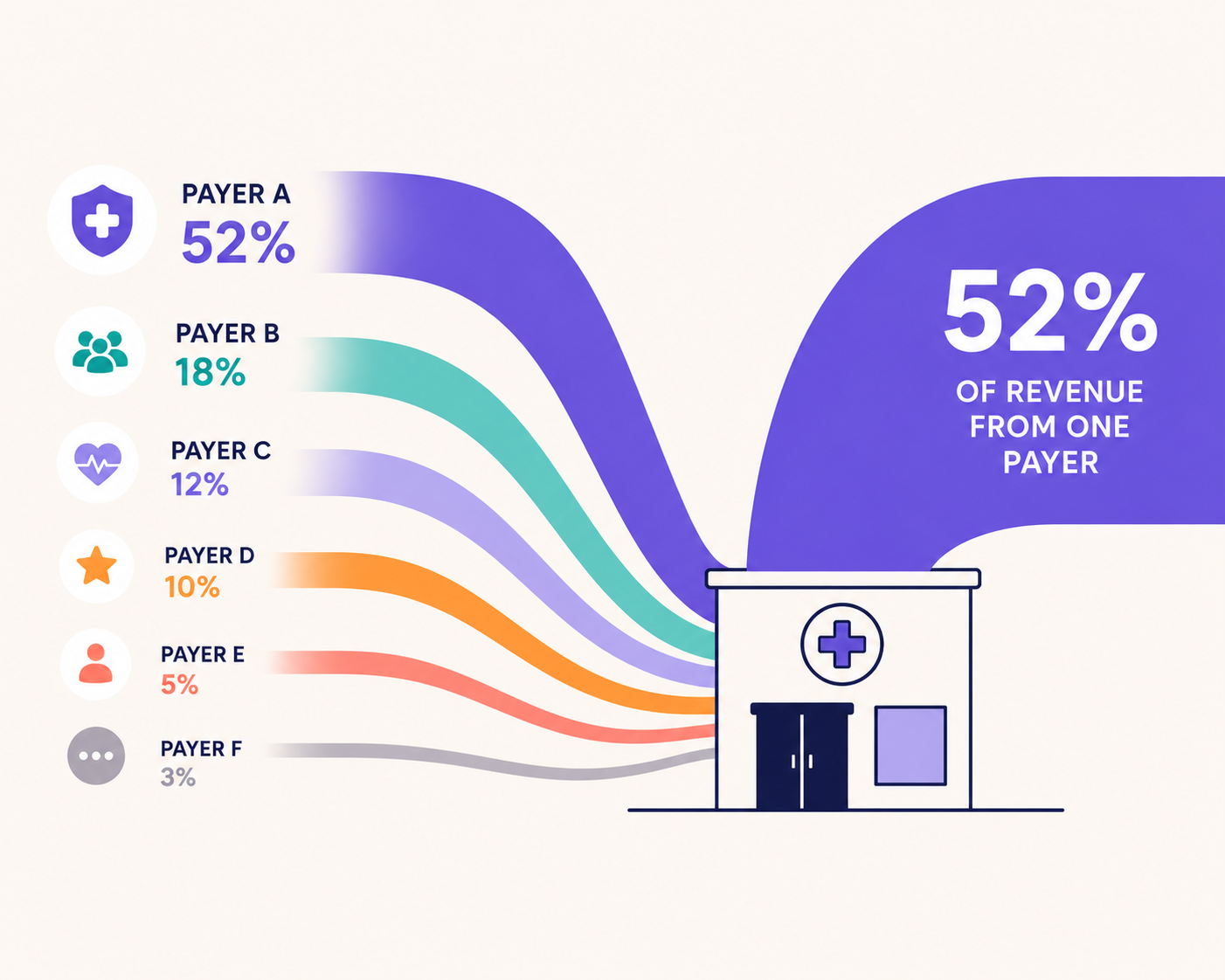
For payer-dependent practices, reimbursement still sets an important boundary around workforce decisions. A practice can have strong demand for clinicians and still struggle to add capacity if its reimbursement mix does not support the fully loaded cost of the role.
Flychain’s guide to payer concentration risk explains one way to evaluate that constraint.
If a practice is considering outside capital for a larger investment, Flychain’s healthcare practice financing guide provides a separate overview of the available options. Financing is not the focus of this HR guide, but it can be relevant when timing a major expansion.
Flychain supports this planning with bookkeeping plus CFO Hub tools including expense benchmarking, salary benchmarking, and contracted rate analysis. Those inputs can help owners test whether a workforce plan fits the economics of the practice. For the accounting infrastructure behind that analysis, see Flychain’s guide to choosing medical accounting software for a growing practice.
Bottom line: Workforce planning is strongest when practice leaders connect staffing needs to caseload, compensation, reimbursement, and cash flow before making a long-term commitment.

What Should Healthcare Practice Leaders Do About These HR Trends in 2027?
The HR trends in the healthcare industry heading into 2027 point in the same direction: practice leaders need better operating discipline around people.
Automation can remove repetitive work, but it does not replace management. Retention requires role-level data and a credible employee experience.
Compensation needs local benchmarks. Compliance needs clear ownership. Workforce plans need to reflect the economics of the practice without turning every HR decision into a finance project.
Start with the trend creating the most operational friction in your practice today.
For an ABA provider, that may be RBT turnover or BCBA capacity. For a pediatric therapy group, it may be recruiting and retaining SLPs, OTs, or PTs across locations. For a behavioral health practice, it may be clinician capacity, credentialing, or compensation consistency.
If the limiting question is what the practice can sustainably support, that is where clean financial data becomes useful: it gives owners a boundary for hiring, compensation, and benefit decisions without making finance the purpose of the HR strategy.
HR Trends in Healthcare Industry: FAQs
What HR metrics should an ABA or pediatric therapy practice track?
Start with metrics that connect people to care capacity: turnover by role and location, 30/60/90-day attrition, time to fill, time from hire to productive caseload, clinician utilization, supervision capacity, and staffing-related cancellations. Compensation data is most useful when segmented by role, geography, experience, and employment model.
How often should healthcare practices benchmark employee compensation?
At minimum, review compensation annually and whenever hiring conditions materially change. Multi-location practices should compare pay by role and geography, while also considering benefits, flexibility, workload, supervision responsibilities, and advancement opportunities rather than looking only at base pay.
Should a small healthcare practice use a PEO or manage HR internally?
There is no single model that fits every practice. Smaller practices may keep core administration in-house, use payroll or HR software, engage an HR consultant, or use a PEO for selected payroll, benefits, and employment-administration functions. The right setup depends on headcount, states of operation, internal expertise, and workforce complexity.
What should a healthcare practice check before using AI in hiring?
Confirm what the tool evaluates, what data it receives, how results are reviewed by a person, and how applicants can request a reasonable accommodation. Practices should also assess whether the tool could create discriminatory outcomes and check applicable state or local rules. In New York City, covered automated employment decision tools are subject to bias-audit and notice requirements.
How should a healthcare practice plan headcount before opening a new location?
Build the plan from expected patient demand and clinical capacity. Estimate the roles required, credentialing and payer-enrollment lead times, supervision needs, compensation and benefits, onboarding costs, and the point at which each hire can support a productive caseload. Then test the plan against reimbursement, margins, and cash flow before making long-term commitments.
How do multi-state healthcare practices manage different HR requirements?
Review employment requirements before the first hire in each new state. Assign clear ownership for wage-and-hour rules, leave, pay transparency, final-pay requirements, required postings, payroll, and benefits administration, while separately managing clinical licensure, credentialing, supervision, privacy, and payer requirements.
Sources for AI-employment guidance: U.S. Equal Employment Opportunity Commission; New York City Department of Consumer and Worker Protection.
Article written by Simone Deverall and Ethan Schwarzbach, Co-Founder & CEO, Flychain.